

For beauty brand owners, distributors, salon chains, and international importers, understanding private label shampoo cost is essential before committing to manufacturing.
A supplier may offer an attractive price per bottle, but that number rarely tells the whole story. Formula development, packaging components, minimum order quantities (MOQ), quality testing, shipping arrangements, and unexpected production expenses can all affect your actual investment.
The challenge is not simply finding the lowest factory quotation. It is understanding precisely what the quotation includes and how much each finished, saleable bottle will ultimately cost your business.
In this guide, Yedda Hair Care explains how to evaluate custom shampoo manufacturing cost, compare OEM quotations, identify hidden charges, and make more informed purchasing decisions.
Whether you are introducing your first private label shampoo or expanding an established hair care portfolio, these calculations can help you build a more realistic manufacturing budget.
1. What Determines Private Label Shampoo Cost?
Private label shampoo manufacturing involves several interconnected expenses.
A useful starting point is to divide your budget into three categories:
- Recurring manufacturing costs: Formula ingredients, bottles, closures, labels, filling, assembly, and standard production quality control.
- One-time development costs: Custom formulation, artwork preparation, specialized packaging tooling, and initial testing.
- Delivery and market-entry costs: Freight, insurance, import duties, customs clearance, destination testing, and other applicable compliance expenses.
These costs should not be combined into one unexplained figure.
For example, a quotation of $1.50 per bottle might include a filled shampoo bottle and standard label but exclude an individual carton, third-party testing, and international freight.
Another supplier may quote $1.85 per bottle with more components and services included.
Without comparing identical specifications and quotation terms, the cheaper-looking offer might actually be more expensive.
Understand the Difference Between Unit Price and Landed Cost
The factory unit price is the amount charged for each manufactured unit under the agreed commercial terms.
The landed cost is the total cost of bringing the product to the specified destination, including applicable freight and import expenses.
For a simplified calculation:
For a complete commercial profitability calculation, you should also account for warehousing, fulfillment, marketplace fees, marketing, and product returns. These are generally downstream operating costs rather than manufacturing costs.
This distinction helps prevent expensive pricing mistakes.
2. Shampoo Formula Costs: Standard vs. Fully Customized
The formula is one of the most important variables in custom shampoo manufacturing cost.
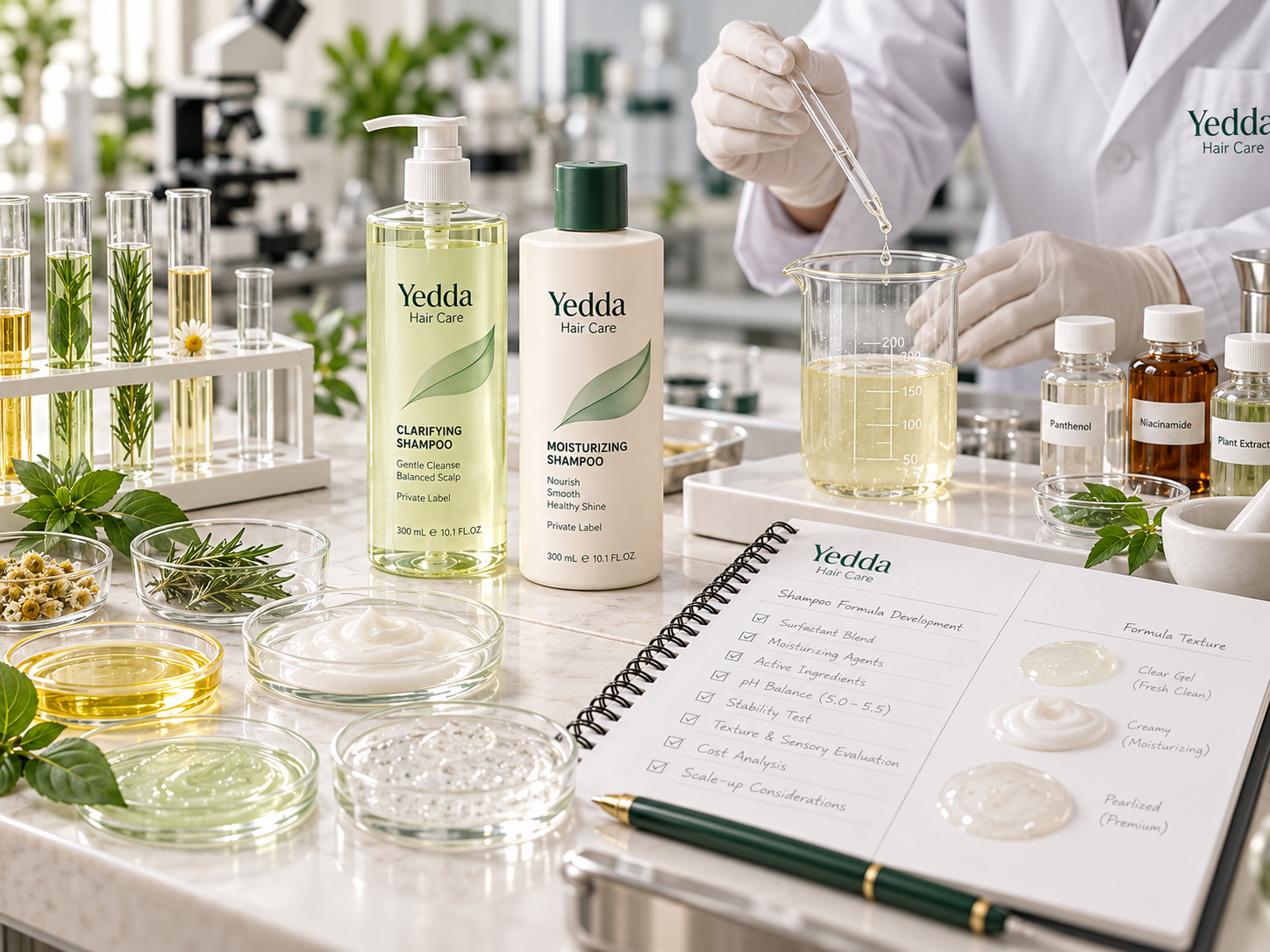
Two products containing the same volume of shampoo may have very different manufacturing expenses because of their ingredient systems, processing requirements, and performance specifications.
Standard Private Label Formulas
A standard private label formula uses an existing manufacturing base that can be selected and branded for a particular customer.
This approach can reduce development work and simplify production.
It may be appropriate for brands launching products such as:
- Daily moisturizing shampoo
- Oil-control shampoo
- Gentle cleansing shampoo
- Repair-focused shampoo
- Salon-use shampoo
At Yedda Hair Care, buyers can explore existing shampoo formula concepts and customize the product presentation according to their brand positioning.
Explore Yedda's Private Label Shampoo Solutions
Standard formulations may reduce upfront development expenses, but buyers should still confirm whether fragrance changes, packaging changes, or additional testing generate separate fees.
Fully Customized Shampoo Formulas
Custom formulation provides greater flexibility for brands developing a distinctive product.
Development requirements may include:
- A specified surfactant system
- Particular conditioning polymers
- Premium botanical ingredients
- Custom fragrance profiles
- Specialized viscosity or sensory characteristics
- Defined ingredient exclusions
- Performance testing requirements
For example, a sulfate-free shampoo using a specialized surfactant blend may have a different raw material and processing cost from a conventional cleansing formula.
Premium ingredients can also influence cost, although the ingredient name alone is not enough to determine the price. The concentration, grade, supplier, and compatibility with the overall formula matter.
Questions to Ask About Formula Pricing
Before approving a custom shampoo formulation, ask your manufacturer:
- Is formula development included in the quoted price?
- How many sample revisions are included?
- Are specialized ingredients subject to additional minimum purchase quantities?
- Who owns the final formula and supporting intellectual property?
- Are stability and preservative efficacy tests included?
- Will future formulation changes require a new development fee?
These questions make a substantial difference when comparing suppliers.
3. Shampoo Packaging Costs: Where Small Details Become Expensive
Packaging is more than a branding decision. It directly affects component purchasing, filling-line compatibility, product protection, transport efficiency, and manufacturing cost.
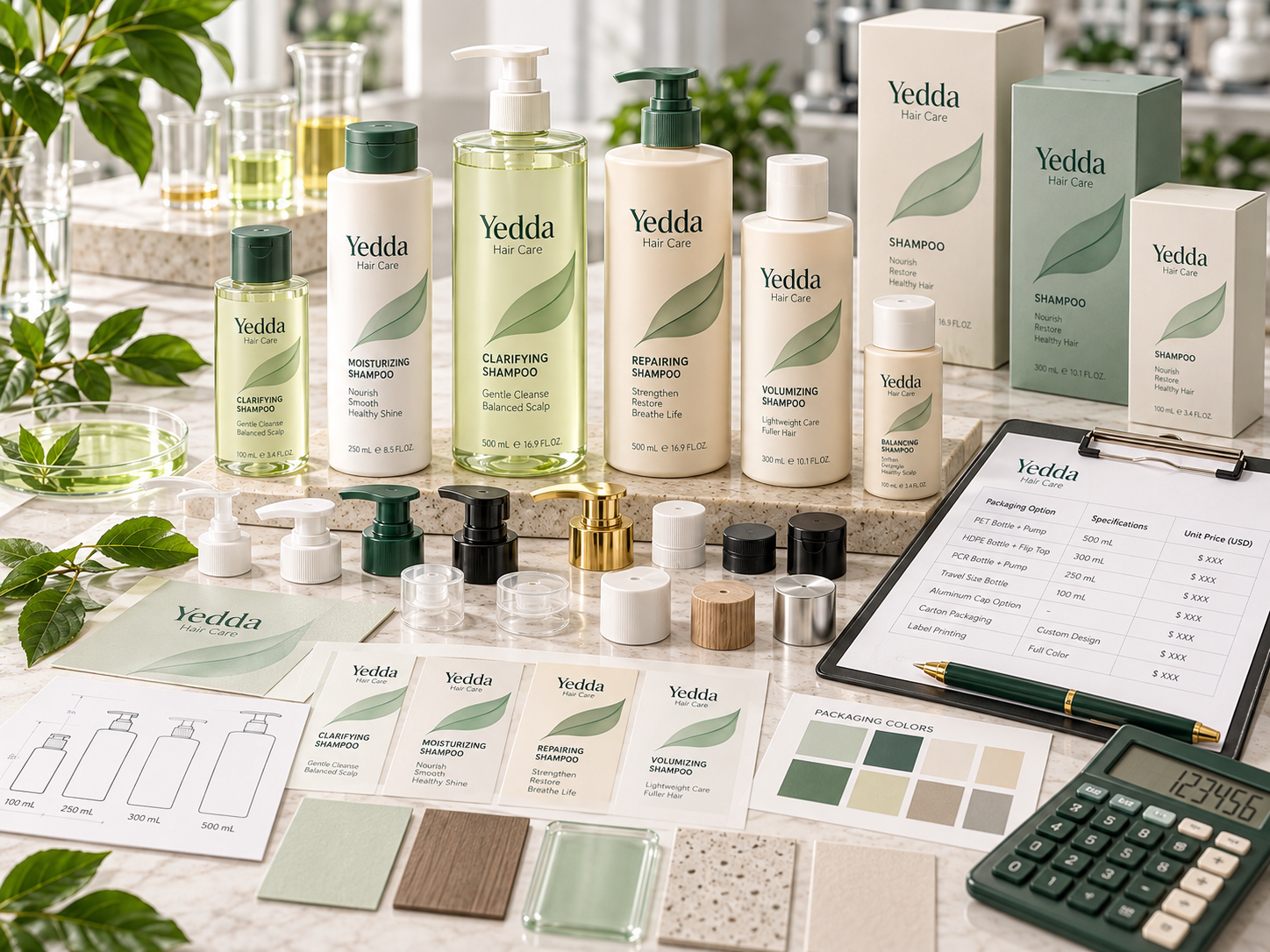
A shampoo packaging quotation may involve several separate items.
| Packaging Component | Main Cost Considerations |
|---|---|
| Bottle | Material, volume, weight, shape, and color |
| Closure | Flip-top cap, screw cap, or pump dispenser |
| Decoration | Printed label, screen printing, or other finishing |
| Secondary Packaging | Individual retail carton or sleeve |
| Shipping Carton | Carton specification and units per case |
| Protective Materials | Dividers, seals, or additional protective inserts |
Standard Bottles vs. Custom Bottle Molds
Using an existing bottle design often reduces initial investment because the packaging supplier already has production tooling.
A custom bottle shape may require new molds, prototype approval, and larger component purchase quantities.
For a new shampoo brand, standard packaging with distinctive colors, labels, and fragrance positioning can offer an effective balance between brand differentiation and budget control.
For established brands, custom packaging may become more attractive when production volumes justify the tooling expense.
Hidden Packaging Expenses to Verify
Ask whether your quotation includes:
- Bottle and cap as a complete set
- Pump dispensers, where applicable
- Label printing and label application
- Leak-prevention seals
- Individual retail cartons
- Export cartons and pallet preparation
- Packaging compatibility testing
- Allowances for defective or damaged components
It is also important to establish responsibility for leftover packaging inventory when the packaging supplier's MOQ exceeds your finished-product order quantity.
4. MOQ and Its Effect on Unit Manufacturing Cost
Minimum order quantity is a critical part of private label shampoo cost planning.
MOQ is not simply a factory purchasing restriction. It can affect raw material sourcing, packaging availability, production-line efficiency, and overall capital requirements.
For Yedda Hair Care, the published standard private label program typically starts at 1,000 units per SKU, while fully customized formulas or specialized packaging typically involve 3,000–5,000 units per SKU. Final quantities are subject to project specifications and commercial confirmation.
Why Larger Orders Can Reduce the Unit Price
Certain manufacturing expenses must be incurred regardless of the batch size.
These may include:
- Equipment preparation and cleaning
- Production-line setup
- Material handling
- Batch documentation
- Quality-control activities
- Packaging line changeovers
When these expenses are spread across more finished units, the fixed-cost contribution per unit generally decreases.
However, a lower unit price does not automatically mean a lower-risk investment.
Example: Comparing Two Order Quantities
Consider the following hypothetical supplier quotations for the same shampoo specification:
| Cost Factor | 1,000 Units | 5,000 Units |
|---|---|---|
| Quoted Unit Price | $2.20 | $1.65 |
| Total Manufacturing Cost | $2,200 | $8,250 |
| Unit Price Difference | — | $0.55 lower |
| Total Inventory Investment | Lower | Higher |
Illustrative figures for calculation only. These are not Yedda Hair Care quotations or verified industry averages.
Although the larger order has a lower unit price, it requires substantially more upfront manufacturing expenditure.
For a new brand with uncertain sales velocity, excess inventory can create storage costs, cash-flow pressure, and expiration-related risks.
For an established distributor with predictable demand, a larger order may provide better procurement economics.
MOQ per SKU vs. MOQ per Order
Always clarify whether the quoted MOQ applies to:
- Each formula
- Each fragrance
- Each bottle size
- Each label design
- Each individual finished-product SKU
- The combined purchase order
For example, ordering 1,000 units across four different shampoo variants does not necessarily satisfy a factory's 1,000-unit-per-SKU requirement.
This distinction should be confirmed before approving packaging artwork or paying a deposit.
5. A Practical Custom Shampoo Manufacturing Cost Example
One of the most useful ways to evaluate an OEM quotation is to request an itemized unit-cost breakdown.
Consider a hypothetical order of 3,000 bottles of 300 mL shampoo.
The following figures demonstrate how a procurement team could evaluate manufacturing expenses.
Illustrative Manufacturing Cost per Bottle
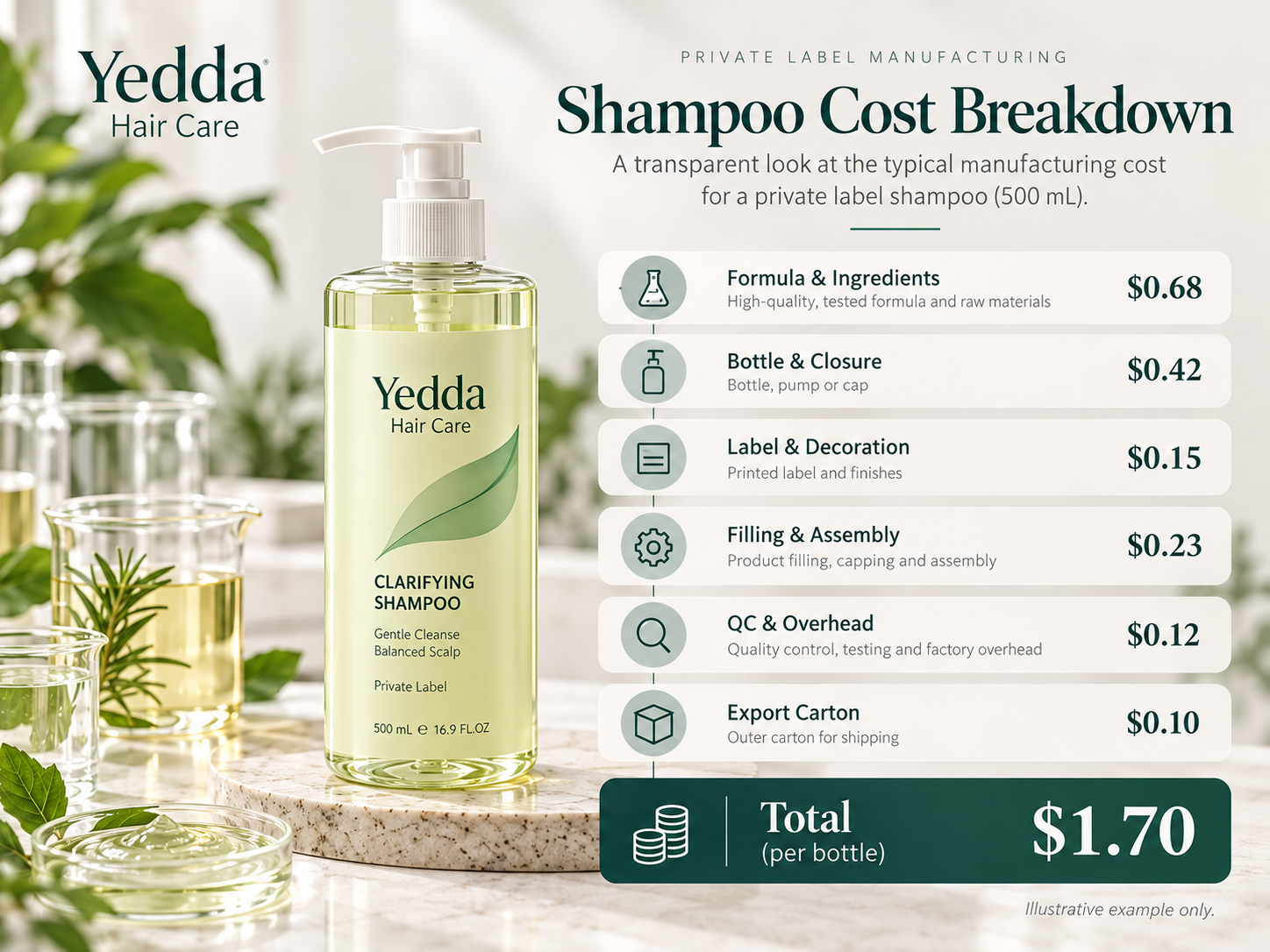
| Cost Component | Example USD per Bottle |
|---|---|
| Shampoo Formula and Raw Materials | $0.68 |
| Bottle and Closure | $0.42 |
| Label and Decoration | $0.15 |
| Filling and Assembly | $0.23 |
| Standard Batch QC and Manufacturing Overhead | $0.12 |
| Export Carton Allocation | $0.10 |
| Illustrative Finished-Goods Unit Cost | $1.70 |
At 3,000 units:
This is the illustrative manufacturing cost before additional one-time and international delivery expenses.
Adding Project-Level Expenses
Suppose the same project involves the following hypothetical additional costs:
| Additional Expense | Example Amount |
|---|---|
| Custom Formula Development | $600 |
| Additional Testing | $450 |
| Artwork Setup | $150 |
| International Freight and Cargo Insurance | $900 |
| Import Duties and Clearance-Related Charges | $400 |
| Total Additional Expenses | $2,500 |
The resulting example is:
- Manufacturing cost: $5,100
- Additional project expenses: $2,500
- Total modeled project cost: $7,600
Assuming all 3,000 bottles are saleable:
This example illustrates why an initial factory price of $1.70 per bottle should not be treated as the complete landed cost.
The $2.53 figure is not an actual factory quote. It is a budgeting illustration. Specific import charges depend on destination, customs classification, declared value, and applicable requirements.
6. Hidden Fees in Private Label Shampoo Manufacturing
Unexpected costs are particularly problematic when they arise after a buyer has approved the production budget.
A transparent quotation process should identify potential charges before purchase order confirmation.
6.1 Formula Revisions and Additional Samples
A manufacturer may provide initial samples but charge separately for extensive formula modifications, new fragrance development, or additional rounds of testing.
Confirm how many revisions are included and what constitutes a billable change.
6.2 Packaging Tooling and Print Setup
Custom bottle molds, printing plates, specialized finishes, and label preparation can generate one-time expenses.
Ask whether these costs are refundable, reusable, or allocated to future orders.
6.3 Packaging Component Overruns
A packaging supplier may require 5,000 bottles even when the finished shampoo order is only 3,000 units.
Determine whether the buyer must purchase the remaining 2,000 bottles, whether they can be stored for future production, and who owns the unused inventory.
6.4 Stability and Microbiological Testing
Testing requirements depend on the product formula, applicable regulations, and intended market.
Potential expenses include stability assessment, packaging compatibility, microbiological quality testing, and preservative efficacy testing.
Clarify which tests are included in the manufacturer's standard quality program and which require external laboratories.
6.5 Regulatory Documentation and Label Review
Different markets may require different documentation and responsible-party arrangements.
For example, an EU cosmetic product generally requires a Cosmetic Product Safety Report, Product Information File, EU Responsible Person, and CPNP notification before market placement.
In the United States, applicable requirements can include obligations under the Modernization of Cosmetics Regulation Act of 2022, subject to exemptions and product-specific circumstances.
Certain therapeutic claims may change a product's regulatory classification.
Never assume that a factory quotation automatically includes all market-entry compliance services.
6.6 Freight, Customs, and Delivery Charges
Shipping costs depend on the agreed Incoterm and service scope.
A quotation under EXW, FOB, or DDP terms can create very different buyer responsibilities.
Ask for the exact named delivery point and the Incoterms version being used.
For DDP quotations, confirm the scope of duties, taxes, destination handling, and any exclusions.
6.7 Production Changes After Approval
Late changes to fragrance, artwork, bottle design, or order quantity may cause additional expenses or production delays.
The best way to avoid these costs is to approve a complete product specification before manufacturing begins.
7. How to Compare Shampoo OEM Quotations Correctly
When requesting prices from multiple manufacturers, ensure each supplier quotes against the same specifications.
Otherwise, price comparisons can be misleading.
Use a Standardized RFQ Checklist
Include the following information in your request for quotation:
| RFQ Field | Information to Provide |
|---|---|
| Product Type | Example: Moisturizing shampoo |
| Fill Volume | Example: 300 mL |
| Formula | Stock formula or custom formulation |
| Ingredients | Required ingredients or exclusions |
| Fragrance | Standard, customized, or fragrance-free |
| Packaging | Bottle material, closure, decoration |
| Order Quantities | Example: 1,000 / 3,000 / 5,000 units |
| Target Market | USA, EU, UK, Middle East, etc. |
| Label Requirements | Language and artwork specifications |
| Testing | Required reports and compliance documents |
| Delivery Term | EXW, FOB, or another agreed Incoterm |
| Destination | Named port or delivery location |
| Timeline | Target sample and production dates |
Request separate prices for different order quantities so your team can evaluate the trade-off between purchasing cost and inventory exposure.
Questions Every B2B Buyer Should Ask
Before placing an order, confirm:
- Is the unit price for a complete finished product?
- Which packaging components are included?
- Are samples and revisions charged separately?
- Is pricing based on the confirmed formula specification?
- What are the MOQ requirements per SKU?
- What testing and documentation are included?
- Who is responsible for surplus packaging materials?
- What deposit and balance payment terms apply?
- How are defective units and shortages handled?
- How long is the quotation valid?
A clear, written quotation makes supplier comparisons easier and reduces the likelihood of disputes.
Get a Custom Shampoo Manufacturing Quote
Planning a private label shampoo line? Share your formula, packaging, order quantity, and target market with Yedda Hair Care.
Our team can discuss suitable OEM/ODM manufacturing options based on your project requirements.
Request an OEM/ODM Quote8. How to Reduce Manufacturing Cost Without Sacrificing Product Quality
Cost optimization should focus on unnecessary complexity, inefficient purchasing, and avoidable project expenses.
Cutting essential quality controls or compromising product safety is not a sustainable cost-saving strategy.
Choose Customization Where It Matters Most
Not every product needs a completely new formula, custom bottle mold, and complex secondary packaging.
A brand may achieve meaningful differentiation through a carefully selected formula, fragrance, visual identity, and clear product positioning.
Standardize Packaging Across Multiple SKUs
Using compatible bottle sizes and closure systems across a product range can simplify purchasing and packaging operations.
For example, a moisturizing shampoo and repair shampoo may share the same bottle style while using different artwork.
Confirm component-level purchasing arrangements with your manufacturer before assuming volume discounts.
Compare Multiple Order Scenarios
Evaluate manufacturing costs at different quantities alongside forecast demand, storage expenses, and available working capital.
The optimal MOQ is the quantity that supports commercial demand without creating unacceptable inventory exposure.
Finalize Specifications Before Production
Frequent changes to artwork, fragrance, or packaging may create additional charges.
A documented approval process helps reduce avoidable rework.
Evaluate Total Cost Rather Than Only Price per Bottle
A reliable supplier relationship should support predictable quality, clear specifications, consistent production, and transparent communication.
A slightly higher manufacturing quotation can sometimes offer better commercial value if it reduces defects, delays, or unexpected charges.
9. Work With Yedda Hair Care for Private Label Shampoo Manufacturing
Yedda Hair Care provides OEM and ODM hair care manufacturing support for brands developing private label hair care products.
Our shampoo development services cover multiple product concepts, including moisturizing, repair, oil-control, scalp-care, and specialized shampoo formulations.
Depending on project requirements, buyers can discuss existing formula options, custom development, fragrance selection, bottle packaging, labeling, and manufacturing arrangements.
We encourage overseas buyers to provide their intended product specifications, order quantities, and target market so that quotation discussions can focus on realistic manufacturing requirements.
Learn more about our private label hair care services and manufacturing solutions.
Request a Customized Shampoo Manufacturing Quotation
Planning a new shampoo product or comparing OEM manufacturing options?
Contact Yedda Hair Care to discuss your formula, packaging, MOQ, and target market.
To help our team prepare your quotation, please include:
- Your preferred shampoo type
- Bottle size and packaging requirements
- Estimated order quantity
- Target selling market
- Required customization
- Expected purchasing schedule
Explore Our Private Label Shampoo Service
Request a Custom Manufacturing Quote
10. Frequently Asked Questions About Private Label Shampoo Cost
How much does private label shampoo cost per bottle?
There is no universal price per bottle. Actual manufacturing costs depend on formula specifications, fill volume, packaging, order quantity, testing, and included services. A reliable supplier should provide a quotation based on your project rather than an unsupported generic price estimate.
What is the difference between private label shampoo cost and custom shampoo manufacturing cost?
Private label programs often use an existing formula with customized branding and packaging. Custom manufacturing can involve additional formulation development, specialized ingredients, and product testing. As a result, fully customized projects may involve higher development expenses and different MOQ requirements.
What is Yedda Hair Care's minimum order quantity?
Yedda Hair Care's published private label program typically starts at 1,000 units per SKU for standard programs. Fully customized formulations or specialized packaging typically involve 3,000–5,000 units per SKU. Final MOQs depend on the specific product and project requirements.
Does the factory unit price include packaging?
Not necessarily. Some quotations cover complete finished products, while others exclude labels, retail cartons, specialized closures, or other components. Buyers should request a written breakdown of all included materials and services.
Are formula development fees charged once or on every order?
This depends on the manufacturing agreement. Certain development expenses may be charged once, while new product specifications or future formula changes may require additional development. Confirm the fee structure and ownership terms before placing an order.
How do I calculate the landed cost of imported shampoo?
Add the manufacturing cost, allocated one-time expenses, freight, insurance, applicable import duties, and relevant clearance or destination charges. Divide by the number of saleable units. Make sure the calculation reflects the agreed shipping terms and actual destination requirements.
Can I reduce shampoo cost by increasing MOQ?
Larger orders can lower per-unit costs by spreading fixed production expenses across more units and sometimes improving material purchasing terms. However, they also increase total inventory investment. Buyers should compare projected demand and working capital before increasing order quantities.
What hidden expenses should I check before paying a deposit?
Confirm sample revision charges, custom packaging tooling, label setup, independent testing, regulatory documentation, surplus packaging inventory, freight arrangements, and any charges related to production changes.
Conclusion: Calculate the True Cost Before Choosing a Manufacturer
Understanding private label shampoo cost requires more than comparing supplier prices per bottle.
Formula complexity, packaging decisions, MOQ, one-time development expenses, quality requirements, and international logistics all influence the total investment.
The most effective procurement strategy is to work from a clearly defined product specification, request itemized quotations, and calculate your total landed cost before making a purchasing decision.
For international beauty brands, this approach can improve budgeting accuracy, reduce unexpected expenses, and support more sustainable product launches.
If you are evaluating custom shampoo manufacturing cost for a new or existing hair care line, Yedda Hair Care can discuss suitable formulation, packaging, and production options based on your project requirements.