
B2B Whitepaper: Hard Water Hair Defense Formulation Blueprint
For beauty brand owners, DTC founders, and top-tier Amazon sellers navigating the hyper-competitive Western hair care market, there is a notoriously painful, hard-to-diagnose "one-star review and refund trap" that keeps teams up at night:
"Our shampoo formulation performed flawlessly during laboratory testing and focus groups—delivering rich lather and exceptional slip. Yet, the moment we scaled operations across the US West Coast, the UK, or Southern Europe (such as Greece and Spain), verified buyers flooded our listings with scathing reviews, complaining that the product 'leaves hair feeling like straw, causes scalp bumps, or completely fails to build a lather.'"
Faced with spiking return rates and collapsing customer lifetime value (LTV), many brand owners immediately blame marketing mismatches or individual hair types. However, through the lens of cosmetic formulation physics, the hidden culprit destroying your brand's reputation is rarely the product itself, but rather a brutal geographical reality: The Hard Water Crisis.
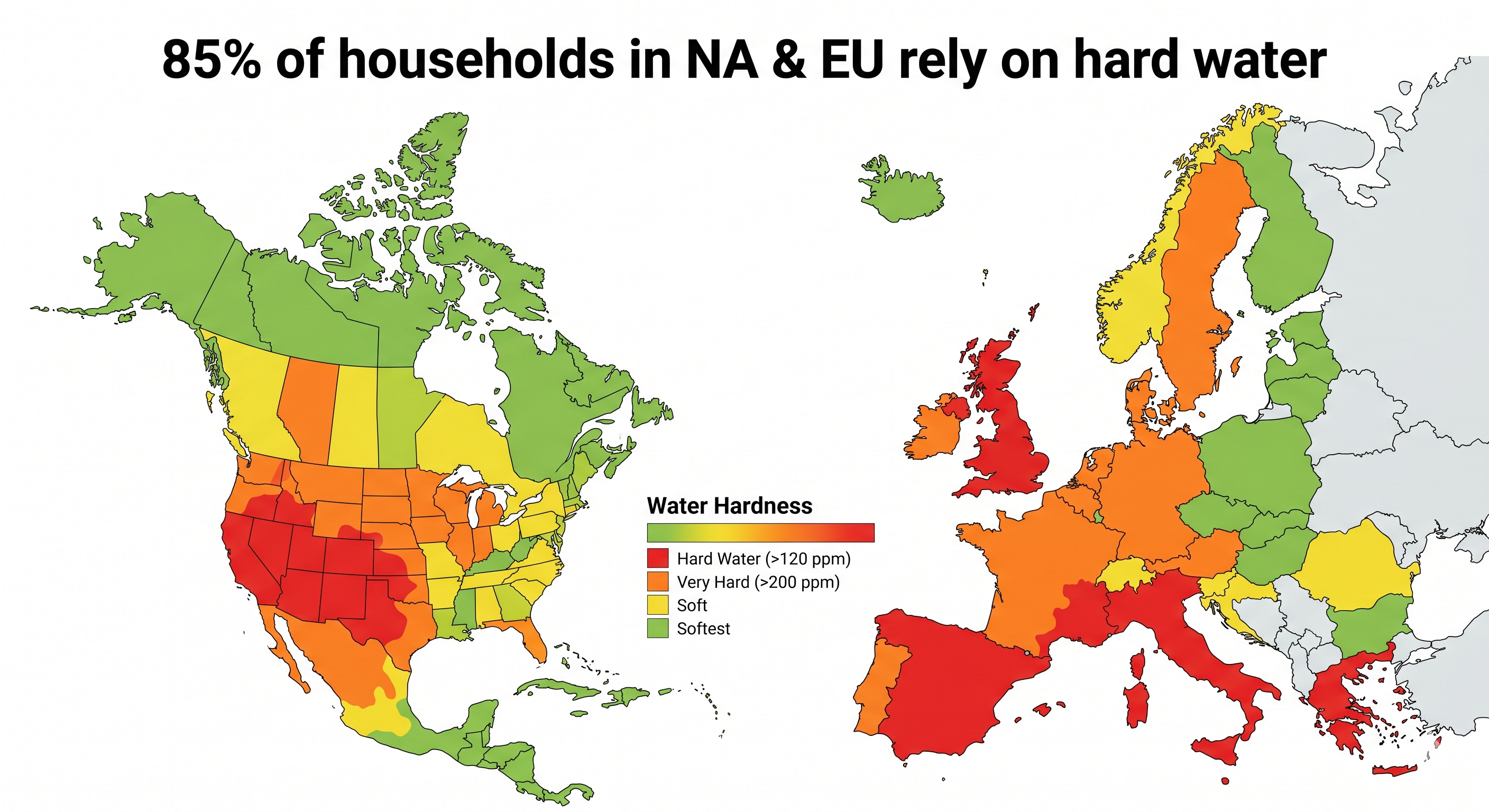
In North America and Europe, over 85% of households rely on heavily hard municipal tap water—which is densely saturated with free-floating Calcium ($Ca^{2+}$) and Magnesium ($Mg^{2+}$) ions. If your supply chain manufacturing partner fails to proactively engineer a formula against mineral deposition, your premium wash products will undergo an immediate chemical collapse the second they meet a consumer's shower water.
For discerning beauty brand innovators, deconstructing how hard water sabotages formulation physics—and converting that knowledge into a "Hard Water Defense" unique selling proposition (USP)—is the ultimate technical barrier to escaping red-ocean price wars and capturing high-margin market shares.
---
Table of Contents
- 1. Molecular Collapse: The Chemistry of Soap Scum Reaction
- 2. The Physical Blockade: How Mineral Films Neutralize Hero Actives
- 3. B2B Formulation Benchmarks: 3 Supply Chain Strategies to Overcome Hard Water
- 4. High-Margin ROI: Monetizing Hard Water Defense into a Premium Product Line
- 5. Frequently Asked Questions (FAQ)
---
1. Molecular Collapse: The Chemistry of Soap Scum Reaction
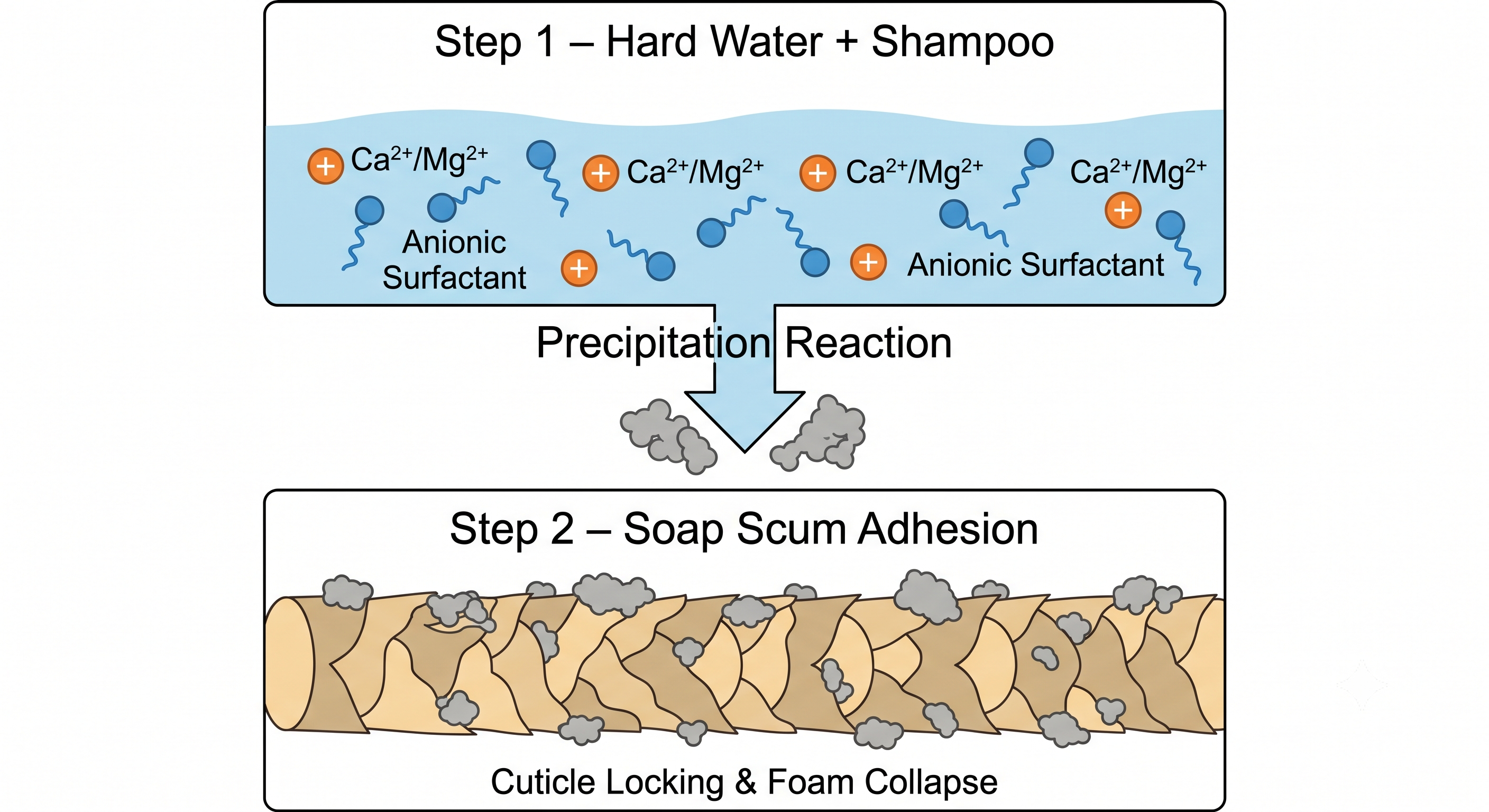
The moment an overseas consumer turns on their shower valve, the highly reactive Calcium ($Ca^{2+}$) and Magnesium ($Mg^{2+}$) ions dissolved in hard water aggressively seek out hydrophilic polar groups to bind with. If your shampoo formulation relies on traditional, cost-optimized anionic surfactants (such as standard sulfates like SLS, SLES, or residual fatty acid sodas), an unavoidable chemical degradation takes place:
$$\text{Anionic Surfactant} + Ca^{2+}/Mg^{2+} \longrightarrow \text{Insoluble Metal Precipitate (Soap Scum)} \downarrow$$
In industrial physics, this insoluble colloidal substance possesses extreme adhesive properties, yielding two catastrophic outcomes that immediately degrade brand equity:
- Instant Foam Suppression: Because a massive percentage of your active surfactant molecules are prematurely captured and precipitated by the hard mineral ions, the shampoo's lather volume plummets by over 60%. Western consumers heavily associate a rich, pillowy foam with cleansing efficacy; a flat, watery lather immediately leads to the perception that the brand is cheap or ineffective, instantly driving refund requests. Brands looking to select the right chassis to avoid this trap can consult our Shampoo Brand Selection OEM Guide.
- Mechanical Locking of the Cuticle: These sticky mineral precipitates resist standard rinsing. Instead, they adhere like a layer of frosted glass directly inside the microscopic shingles of the hair cuticle. As water evaporates, the soap scum hardens, physically trapping the hair cuticles open and leaving the shaft rough, brittle, and completely stripped of natural light-reflectivity. This is the exact molecular root cause behind buyers complaining of "straw-like hair."
According to water quality data published by the United States Geological Survey (USGS), regional water hardness fluctuations directly correlate with regional spikes in cosmetic return rates—a variable that most standard contract labs fail to calculate.
2. The Physical Blockade: How Mineral Films Neutralize Hero Actives
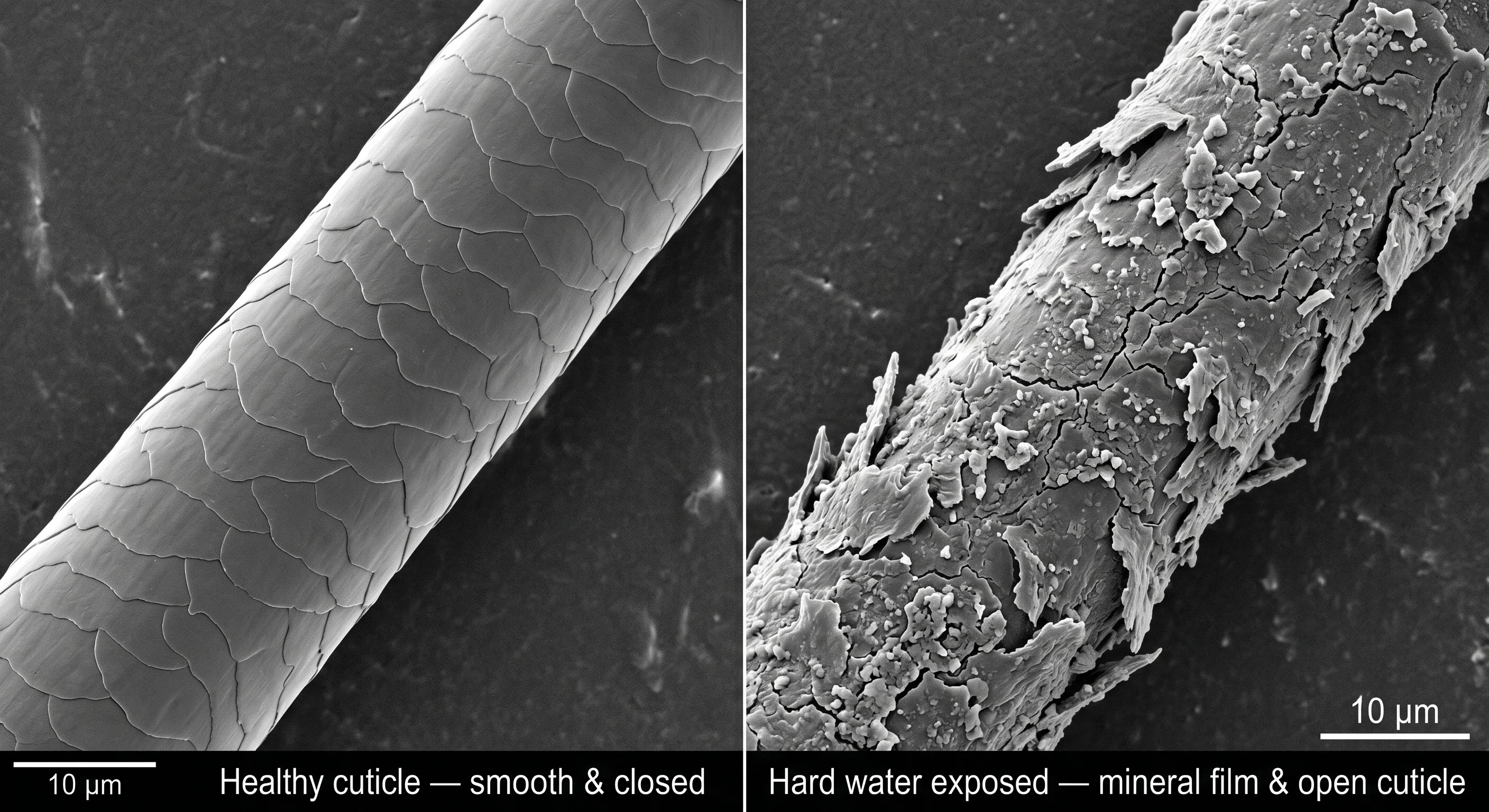
The damage hard water inflicts on a brand's long-term retention rates extends far beyond aesthetics. It migrates upward, building an impassable physical isolation barrier over the stratum corneum that completely neutralizes your brand's downstream, high-cost leave-in treatments.
- Inducing Micro-Inflammation and Acne: The same sticky metal scum deposits onto the scalp's cornified layer and around the openings of the follicular infundibulum. When mixed with the scalp's natural oxidized sebum, it solidifies into a dense Mineral Film. This film disrupts the scalp’s acidic pH equilibrium, turning the follicle into a breeding ground for Malassezia yeast and triggering micro-inflammation—hence the customer complaints of sudden itching and scalp breakouts.
- Neutralizing the Pathway for High-Value Actives: When the consumer steps out of the shower and applies your brand's flagship $50+ leave-in peptide serum or follicle stimulator, they are applying it directly onto this hardened mineral glaze. Water-soluble peptide chains or delicate active molecules cannot diffuse through this mineral crust to reach the subcutaneous dermal papilla cells. Trapped on the surface, your expensive actives are simply wiped away onto a pillowcase or evaporated into thin air.
⚠️ The Brand Owner's Reality Check: Your customers may invest in your entire multi-step system (shampoo + serum), but because your pre-treatment shampoo failed to withstand hard water, your hero leave-in actives are rendered entirely useless. The consumer will never blame their municipal tap water; they will simply conclude your brand is "marketing hype" and leave a devastating digital review.
3. B2B Formulation Benchmarks: 3 Supply Chain Strategies to Overcome Hard Water
Mature, international beauty brands and world-class manufacturing infrastructures integrate "Global Water Hardness Tolerance" as a baseline key performance indicator during initial R&D. To safeguard a brand's listing ratings in hard water regions, industrial formulation chemists implement three rigorous compounding strategies:
Implementing an Advanced Chelating Matrix
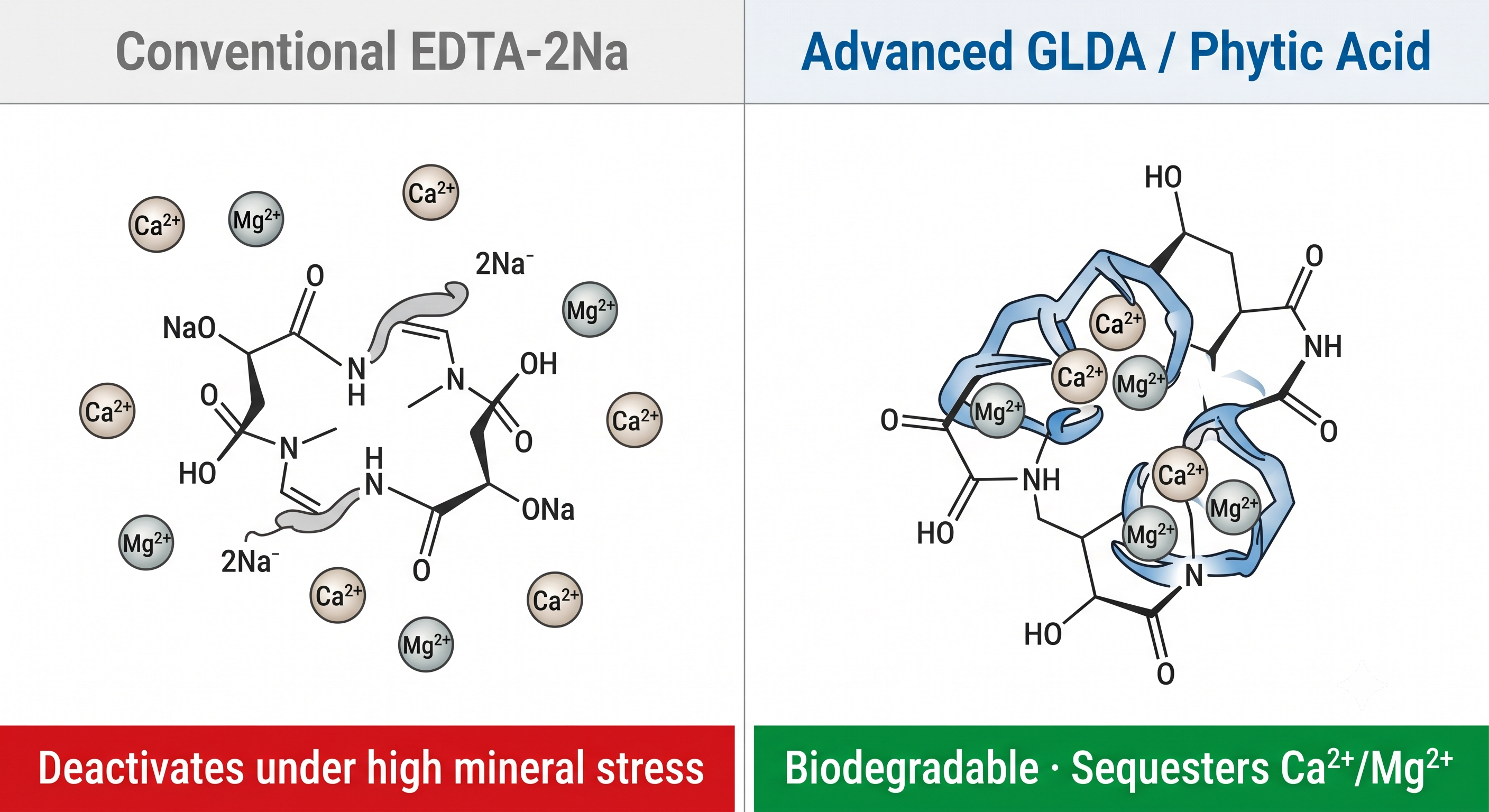
Basic mass-market clarifying shampoos often rely on low-cost EDTA-2Na, which completely deactivates under heavy mineral stress. Premium export-grade formulations require a multi-dimensional green chelating network, utilizing next-generation molecules such as Tetrasodium Glutamate Diacetate (GLDA) or Phytic Acid. These molecules act like microscopic "claw-like magnets," binding and encapsulating $Ca^{2+}$ and $Mg^{2+}$ ions before they can ever touch the surfactant system, entirely preventing scum formation from the source.
Transitioning to Hard-Water Resistant Surfactants
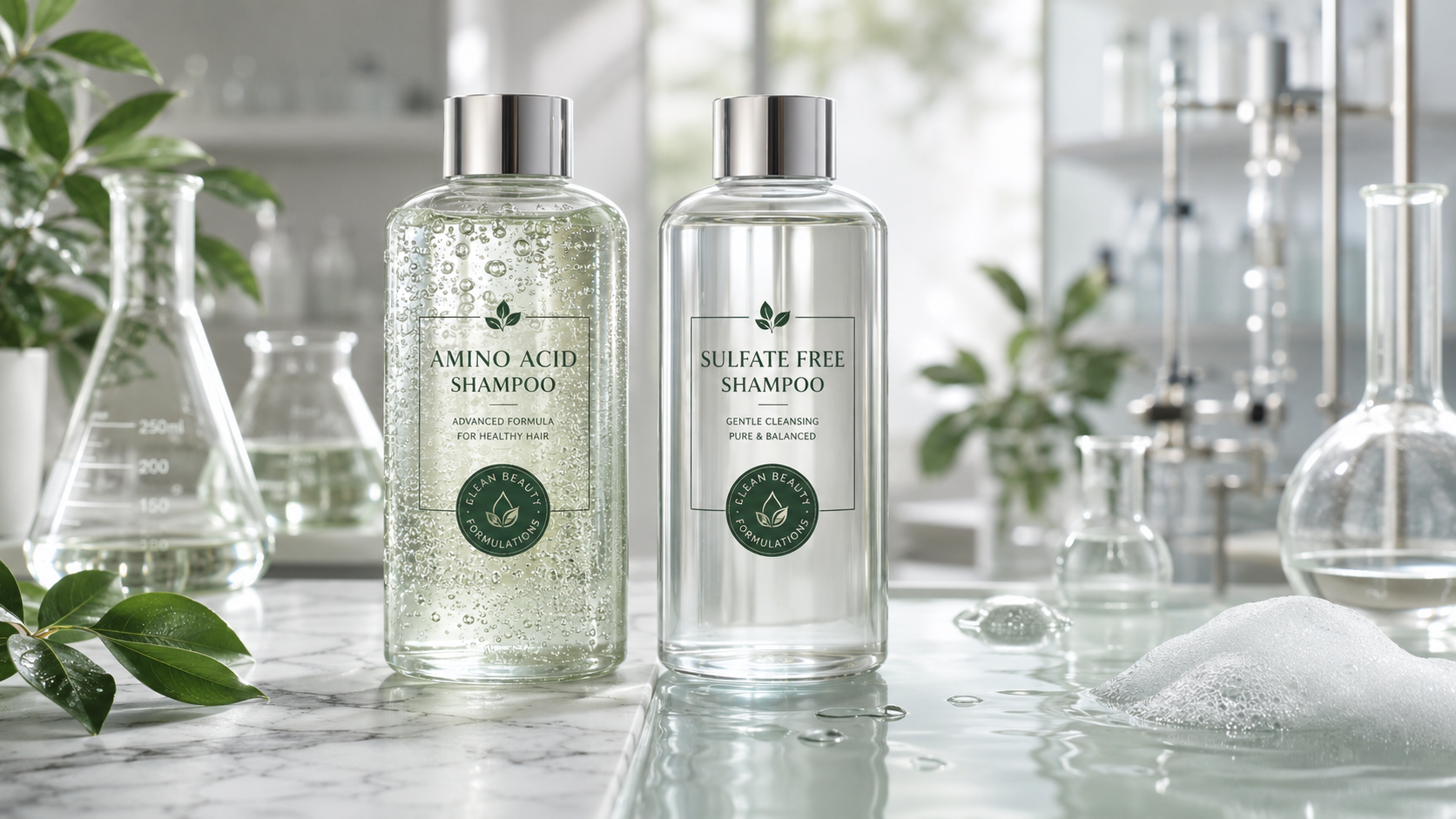
Elite product design bypasses traditional hard-water-sensitive surfactants entirely, shifting toward advanced Amino Acid cleansing bases (e.g., Glutamate types) cross-linked with non-ionic and amphoteric co-surfactants (e.g., Sodium Cocoamphoacetate, Alkyl Polyglucosides - APG). These advanced surfactant structures are molecularly immune to calcium and magnesium ions—maintaining an ultra-dense, luxurious micro-foam and ensuring zero physical deposition even in extreme hard water environments.
Industrial-Grade Double-RO Deionized Water Systems
The purity ceiling of a formulation is determined by the front-end engineering of the supply chain. Advanced contract manufacturing facilities enforce a strict Double-Reverse Osmosis (Double RO) Deionized Processing Water system combined with high-precision vacuum homogenization. This guarantees that every single batch leaves the factory floor at an absolute state of zero-impurity, zero-mineral baseline. This extreme purity not only preserves the long-term chemical stability of sensitive peptides and caffeine during international transit but also maximizes the formula's chemical buffering capacity when encountering tough municipal water abroad.
To visualize the structural differences between these chemical methodologies, review our industrial benchmark comparison below:
| Formulation Parameter | Standard Anionic Formula | Hard Water Defense Formula |
|---|---|---|
| Primary Surfactant Base | Sulfates (SLS / SLES) | Amino Acid (Glutamate) + APG Matrix |
| Chelating Efficiency | Low (Standard EDTA-2Na) | High (Multi-dimensional GLDA Network) |
| Hard Water Lather Retention | Drops by >60% (Watery/Flat) | Maintains >95% (Dense/Pillowy) |
| Mineral Scum Deposition | Heavy (Creates micro-opaque film) | Zero (Complete molecular encapsulation) |
| Downstream Active Penetration | Blocked (Impedes peptide delivery) | Unobstructed (Fully clears follicular pathways) |
📦 For Wholesale & Bulk Buyers: We offer comprehensive formulation customization, contract manufacturing (OEM/ODM), and bulk finished product packaging options through our dedicated OEM/ODM Manufacturing Service. Enjoy highly flexible Minimum Order Quantities (MOQs) tailored to agile brands, backed by full compliance documentation and certifications for major Western markets (US/EU standards).
4. High-Margin ROI: Monetizing Hard Water Defense into a Premium Product Line
While hard water acts as a silent killer for unoptimized brands, it simultaneously represents a rapidly expanding, highly lucrative niche for strategic brand owners looking to entirely bypass red-ocean price wars.
In global consumer spaces, search interest and demand for Chelating Shampoos and Hard Water Hair Defense Treatments are experiencing exponential growth among middle-class demographics. According to market data from the Cosmetics Europe personal care trade association, functional trichological wash variants are outperforming standard cosmetic SKUs in retail margins by nearly 35%.
By leveraging established laboratory innovations, brands can seamlessly execute high-margin product expansions by checking our full Wholesale Products Item Catalog or formulating highly specific target products such as our advanced 500ml Violet Toning Non-Irritating Shampoo, which showcases excellent surfactant stability in hard tap systems.
- Launch a Weekly "Hard Water Detox/Clarifying" Hero Line: Focus explicitly on a specialized treatment designed to deeply purge accumulated calcium, magnesium, copper, and iron mineral buildups from the scalp skin and hair fiber—effectively liberating "suffocating" hair roots. Products in this functional category command retail premiums 2 to 3 times higher than generic daily cleansing shampoos.
- Deploy "Protocol-Driven" Combined Marketing: Structure your e-commerce funnels to educate consumers on a scientific workflow: First, clear the mineral pathway using a high-tolerance, sulfate-free chelating shampoo; second, apply a highly rinse-friendly, clean-rinsing conditioner to neutralize mineral stiffness along the lengths; and third, apply your expensive leave-in growth peptides onto a perfectly prepped scalp. This protocol approach significantly boosts consumer satisfaction ratings while driving phenomenal Average Order Value (AOV) via multi-product bundling.
If you are an established beauty brand owner, cross-border e-commerce enterprise, or global salon distributor looking to scale your portfolio with premium, hard-water resilient technologies engineered for Western markets, aligning with an R&D-driven contract manufacturer is the definitive path to accessing turnkey, lab-tested formulation architectures. To understand how to vet your production partner, read our executive analysis on Direct Factory vs Trading Company OEM Suppliers in China.
5. Frequently Asked Questions (FAQ)
Q1: If our brand positions itself around "100% pure botanical extracts and organic oils," can we solve the brittle hair texture caused by hard water?
A: Frankly, no—and it may actually exacerbate the issue. In a severe hard water environment, relying purely on raw botanical oils is a major chemical miscalculation. The stiffness and lack of shine are caused by the physical precipitation of solid metal-surfactant scum, not a lack of cosmetic oil. To dissolve and prevent this, you must deploy rigorous industrial chemistry: specifically, highly efficient biodegradable chelating agents (like GLDA) to isolate the metal ions, and hard-water-resistant amino acid bases. Slathering unrefined organic oils over existing mineral scum will simply bind the oils to the mineral crust, creating an even heavier, stubborn composite residue that leaves hair looking greasy yet feeling intensely brittle.
Q2: As a brand owner, how can I quickly audit my current contract manufacturer's formula to check for hard water vulnerability?
A: You can easily execute a low-cost, laboratory-grade stress test: Prepare a benchmark hard-water solution calibrated to roughly 300 ppm (easily simulated by dissolving precise ratios of Calcium Chloride and Magnesium Sulfate into distilled water to replicate standard US/EU tap water). Dilute your current shampoo sample into this hard water at a 1:10 ratio and subject it to standardized mechanical agitation. If the solution instantly turns intensely turbid, produces visible white flocculent precipitates, and the resulting foam collapses within 60 seconds, your formula will almost certainly trigger massive consumer complaints regarding flat lather, scalp irritation, and dry texture in major global markets. This indicates an immediate need for an updated chelating matrix.
Q3: Will upgrading our formulations to target hard water (e.g., adding advanced chelating complexes and amino surfactants) severely inflate our B2B procurement costs?
A: This is a common manufacturing misconception. While premium green chelating agents like GLDA and advanced amino acid surfactants carry a higher raw material price per kilogram than standard sulfates, their required inclusion threshold within a balanced shampoo chassis is strictly calibrated at micro-dosages (typically between 0.1% to 0.5% for chelators). Through precise molecular optimization, the net increase in raw material cost per unit is usually measured in mere cents. However, this minor investment yields an 80% drop in refund rates, a triple-digit increase in customer retention, and empowers your brand to directly monetize the high-ticket "Hard Water Defense" claim. From a brand ROI perspective, it is an incredibly profitable supply chain technology investment.
---
The Bottom Line Industrial Whitepaper:
The international success of a premium hair care brand depends entirely on deconstructing the real-world environmental physics of your end consumer. The "metal-surfactant scum reaction" born from hard water is the ultimate root cause behind flat lather, brittle shafts, and the physical blockage of high-value leave-in actives. Escaping empty marketing claims means integrating advanced chelating complexes at the supply chain level, enforcing sulfate-free matrices, and maintaining medical-grade deionized water standards. Establishing a precise "chelating pre-cleansing + targeted deep penetration" protocol is the definitive chemical blueprint for modern functional hair care brands to capture global retention.
---
✅ If you are a brand owner or wholesale buyer requiring finished products or raw material supplies engineered with hard-water resistant technologies, contact our dedicated B2B sales and technical team today to request custom samples and tailored wholesale pricing tiers.