
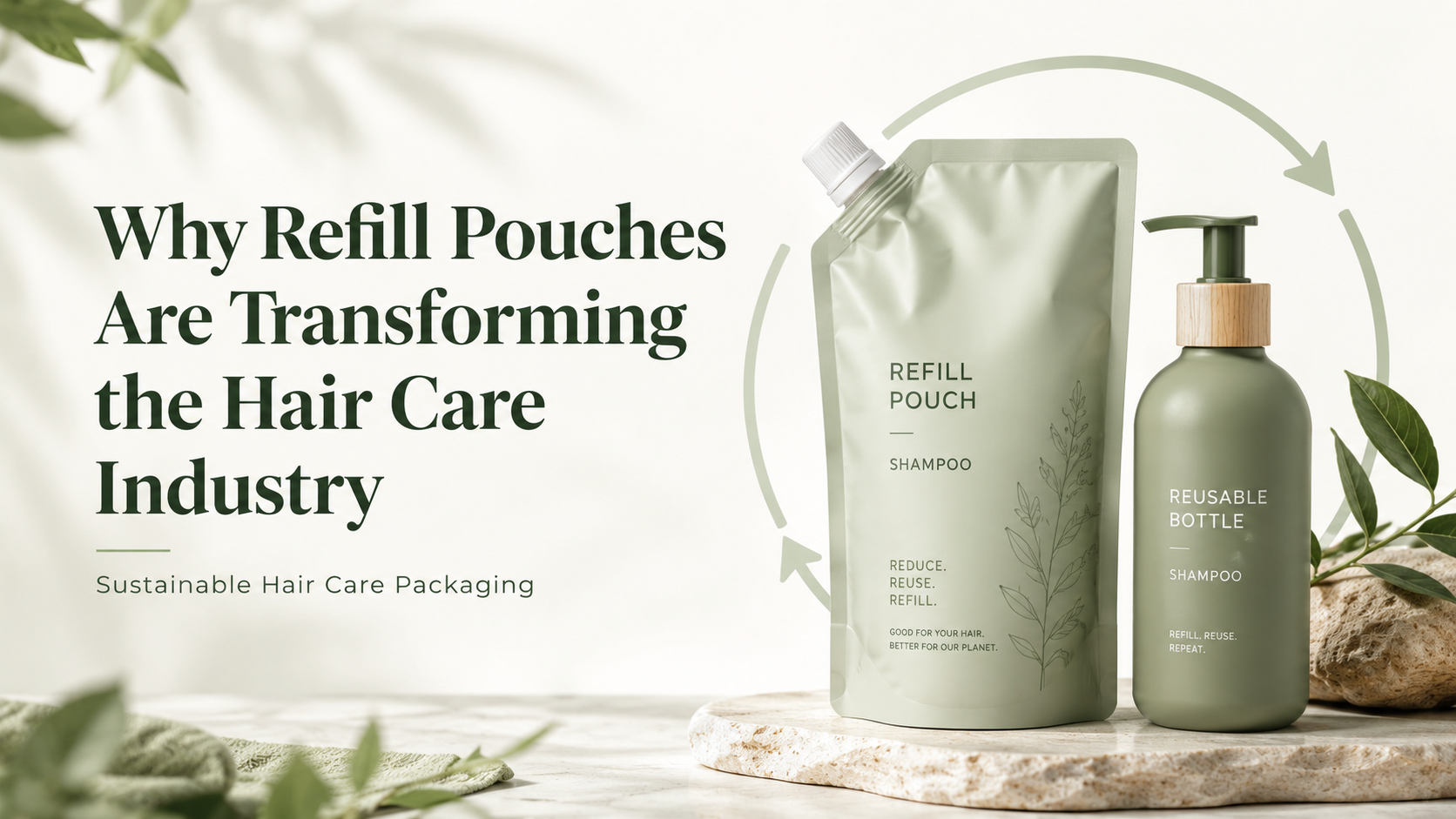
Why the refill shampoo pouch is transforming the hair care industry
The hair care industry is entering a new packaging cycle. For years, shampoo, conditioner, hair masks, scalp care formulas, salon treatments, and professional backbar products were dominated by rigid plastic bottles. These bottles were familiar, stable on shelf, easy to brand, and simple for consumers to use. However, the pressure on brands has changed. Retailers are asking for lower packaging footprints. Consumers are questioning single-use plastics. Governments are tightening packaging regulations. Beauty companies are being pushed to show measurable progress, not just communicate sustainability claims. In this environment, the refill shampoo pouch has moved from a niche alternative to a strategic packaging format for brand owners, private label companies, salon groups, hotels, distributors, and contract manufacturers.
A refill shampoo pouch is not simply a soft bag that replaces a bottle. It is a different business model. It separates the long-life primary bottle from the repeated refill purchase. It reduces the amount of packaging used per milliliter of product. It lowers shipping weight and cube compared with many rigid formats. It also creates a recurring-purchase opportunity because the consumer is encouraged to keep the original bottle and buy the refill again. For B2B buyers, this means refill pouches can influence packaging cost, logistics efficiency, brand positioning, retail merchandising, repeat purchase, and sustainability reporting at the same time.
The timing is important. UNEP’s “Turning off the Tap” report states that the transition away from a throwaway plastics economy requires systems change, including redesign, reuse, refill, and circularity. The same report highlights that only a small share of plastics produced are mechanically recycled, which explains why brands cannot rely on recyclability claims alone.
For the hair care category, refill packaging is especially practical. Shampoo and conditioner are frequently used products. They are often bought repeatedly in the same fragrance, formula, or hair-type range. Many households already keep bottles in the shower for weeks or months. Salons and hotels also use hair care products in high volumes. These conditions make refill adoption easier than in categories where the product is purchased only once or where hygiene and dosing are more complicated.
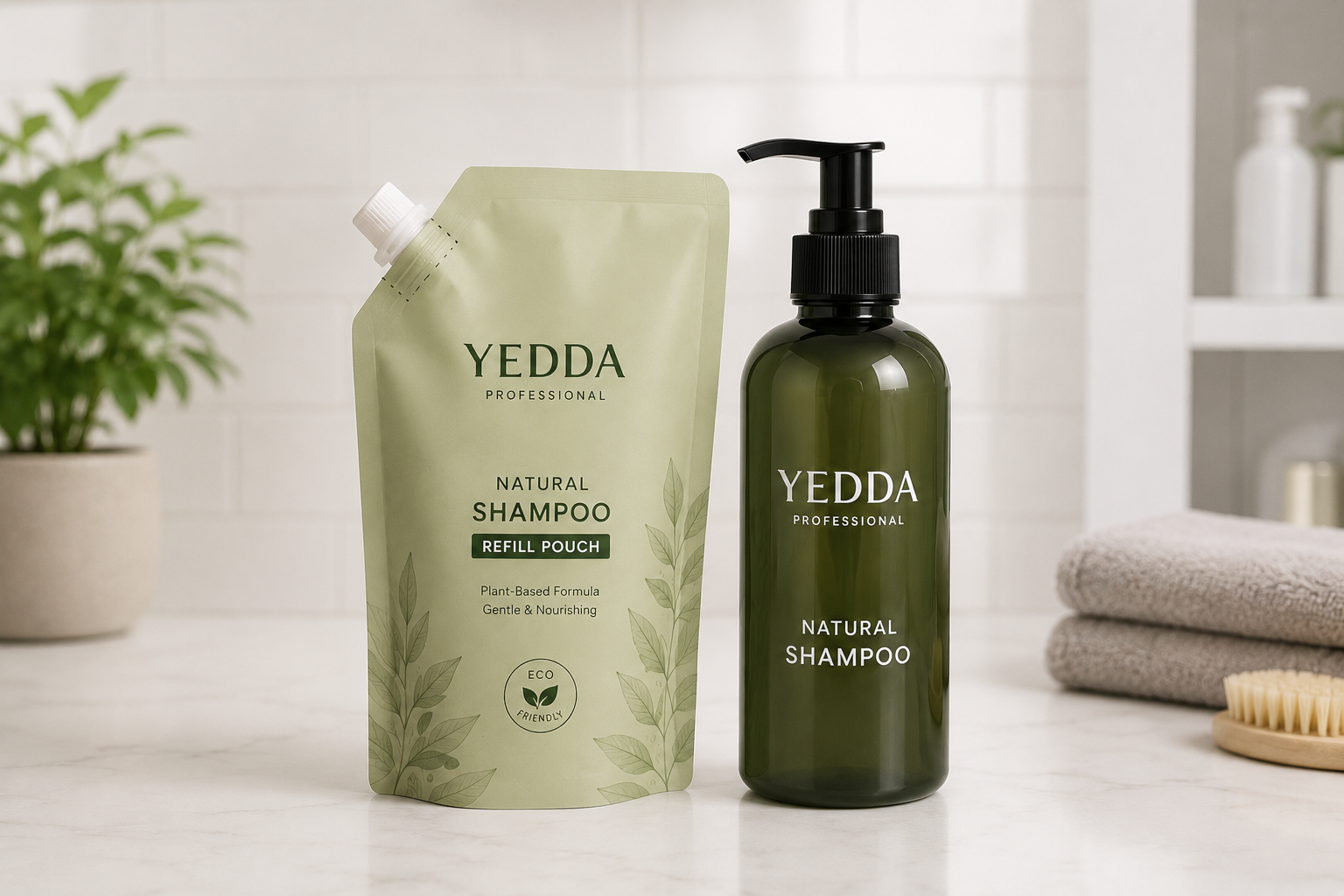
Refill shampoo pouch demand is being shaped by sustainability, cost, and retail pressure
The growth of the refill shampoo pouch is not driven by one factor. It is the result of several pressures converging at the same time. The first pressure is sustainability. Brands need packaging options that visibly reduce material use. The second is cost. Lightweight flexible packaging can reduce transport burden and storage space. The third is retailer expectation. Many retailers now prefer suppliers that can demonstrate progress on packaging reduction, recycled content, refill formats, or lower-impact packaging systems. The fourth is consumer behavior. Once consumers buy a product they like, a refill pouch gives them a practical reason to repurchase without feeling they are creating another empty bottle.
McKinsey’s 2025 global consumer packaging research shows that sustainability attitudes are not identical across every country, which is important for international hair care brands. Buyers may value recyclability, low plastic content, refillability, paper-based formats, or price differently depending on the market. This means B2B teams should avoid generic assumptions and instead match refill pouch strategy with the target region, sales channel, and consumer segment.
From a commercial perspective, refill pouches also help brands solve a common problem: how to talk about sustainability while still protecting product experience. Many alternative packaging formats require consumers to change their habits dramatically. Solid shampoo bars, for example, can work well for some buyers but may not fit every hair type, fragrance preference, or premium positioning. Concentrates may require dilution and education. In contrast, a refill shampoo pouch lets the brand keep the liquid formula that consumers already understand. The consumer simply pours the product into an existing bottle.
This is one reason refill pouches are especially relevant for B2B buyers managing established hair care lines. A brand does not always need to reformulate the product or redesign the entire range. It can launch a refill SKU next to the hero shampoo, conditioner, or treatment product. The refill pouch can support a “buy once, refill many times” model, allowing the brand to keep the original bottle as a premium object while reducing packaging impact over repeat purchases.
Sustainable hair care packaging is becoming a business requirement, not a marketing option
Sustainable hair care packaging used to be treated as a brand storytelling topic. Today, it is increasingly a procurement, compliance, and channel-access topic. Retailers, investors, regulators, distributors, and consumers are asking more specific questions. How much virgin plastic is used? Is the package reusable, recyclable, or refillable? Is the design compatible with existing collection streams? Does the brand have measurable reduction targets? Can the supplier provide documentation?
The Ellen MacArthur Foundation’s Global Commitment 2024 report shows that more than 1,000 organizations have aligned around a circular economy vision for plastics, including companies representing a significant share of global plastic packaging production. For hair care brands, this matters because packaging direction is being shaped by the wider consumer goods economy, not only by beauty trends.
For B2B teams, the practical question is no longer whether sustainability should be mentioned. The question is how to build a packaging system that can survive buyer audits, consumer scrutiny, shipping requirements, and cost reviews. A refill shampoo pouch helps because it directly addresses material reduction. Instead of asking the consumer to accept a completely unfamiliar product, it reduces the amount of packaging attached to each refill cycle.
However, sustainable packaging must be discussed carefully. A pouch is not automatically sustainable in every situation. Its performance depends on the material structure, product compatibility, cap and fitment design, fill weight, transport distance, number of refills, end-of-life options, and whether the original bottle is actually reused. This is why brands should work with an experienced shampoo pouch manufacturer that understands barrier performance, leakage risk, filling line requirements, pouch durability, and market-specific recycling claims.
A strong sustainable hair care packaging strategy should include material reduction, packaging functionality, brand communication, and consumer instructions. If the refill pouch is difficult to pour, leaks during transport, collapses on shelf, or uses unclear disposal language, the sustainability story will not be enough. In B2B markets, performance and credibility must move together.
Eco friendly shampoo packaging must protect the formula first
Many brands search for eco friendly shampoo packaging with the expectation that lower material use is the main decision factor. Material reduction is important, but it cannot come before product protection. Shampoo, conditioner, scalp serum, and hair treatment formulas may contain surfactants, fragrances, essential oils, botanical extracts, preservatives, colorants, proteins, silicones, acids, or actives that interact differently with packaging films. A refill pouch must protect viscosity, fragrance stability, color, microbial quality, and consumer safety through filling, storage, transport, shelf display, and use.
For this reason, B2B buyers should evaluate refill pouch packaging through the same disciplined process used for other primary packaging. Compatibility testing should include formula contact tests, accelerated aging, drop testing, seal strength testing, cap torque checks, leakage testing, and transportation simulation where appropriate. The structure that works for a basic hotel shampoo may not work for a sulfate-free premium formula with a high fragrance load. A pouch for salon backbar use may require different durability than a small retail refill pouch sold through e-commerce.
Good eco friendly shampoo packaging is not only about using less material. It must also reduce product waste. If a pouch fails and product leaks, the sustainability benefit can be lost. If the consumer cannot empty the pouch efficiently, residue waste increases. If the cap clogs or the pouch is hard to grip, repeat purchase may fall. Therefore, the best refill pouch programs combine sustainability claims with practical user experience.
In a B2B sales context, this distinction can help manufacturers and brands communicate more professionally. Instead of making broad claims such as “green packaging” or “earth-friendly packaging,” it is better to explain the measurable benefits: reduced plastic weight compared with a rigid bottle, lower transport weight, refill use case, mono-material options where available, or compatibility with a reusable bottle system. Clear, specific claims reduce greenwashing risk and make the buyer’s decision easier.
Why refill shampoo pouch packaging fits the economics of repeat purchase
Hair care is a repeat-purchase category. A consumer may try a shampoo once, but if the formula works, the same product can be bought many times. This makes the refill shampoo pouch commercially attractive. The first sale can focus on the full bottle, starter kit, pump bottle, aluminum bottle, PET bottle, or premium reusable container. The next sale can focus on the refill pouch. This creates a product ladder: starter pack, refill pack, value pack, travel format, salon size, and possibly subscription refill.
For brands, refill pouches can increase customer retention because the consumer has a reason to stay within the system. If the bottle is attractive and the refill is convenient, the user is less likely to switch to another brand. The refill can also be priced to offer better value per milliliter while still protecting margin because the packaging cost per unit of product may be lower than a rigid bottle format. This does not mean refill pouches are always cheaper in every specification, but they create room for different pricing architecture.
For retailers, refill pouches can support shelf differentiation. A refill pouch next to a standard bottle signals that the brand is thinking beyond a one-time purchase. It also gives retailers an answer to consumers who want more responsible packaging but are not ready to change their hair care routine. In some markets, refill pouches can be merchandised as value packs, eco packs, salon refills, or family-size refills.
For e-commerce, flexible pouches can reduce shipping weight and may improve package density, but they must be designed for parcel handling. The pouch must resist puncture, cap damage, seal failure, and compression. Secondary packaging may still be required. This is another reason to involve a professional shampoo pouch manufacturer early in the project rather than treating pouch selection as a simple artwork conversion.
How refill shampoo pouch formats support sustainable hair care packaging goals
The strongest business case for refill pouches is usually built around reduced material per use. A standard shampoo bottle is designed to stand alone, survive transport, display branding, hold shape, and dispense the product. A refill pouch does not need to perform every one of those functions in the same way because the reusable bottle carries part of the experience. This allows the refill pack to be lighter and more compact.
L’Oréal has publicly stated that in Europe, Elvive refillable pouches reduce plastic use by 60% across several product lines. This type of brand case is important because it shows that refill pouches are no longer limited to small niche companies. Large beauty groups are using refill formats in mainstream categories where volume, supply chain reliability, and consumer acceptance matter.
For sustainable hair care packaging, the pouch model also supports gradual transition. A brand can begin with one bestselling shampoo SKU rather than converting an entire portfolio. It can test one market, one retail chain, one salon network, or one direct-to-consumer program. It can compare repeat rates, customer reviews, leakage data, and cost performance before scaling. This staged approach is attractive for B2B decision makers because it lowers risk.
The pouch also creates new communication opportunities. The brand can print refill instructions, disposal guidance, material information, refill benefits, and QR codes on the pack. Even though this article does not use clickable links due to your HTML restrictions, actual packaging can guide consumers to videos, lifecycle information, or refill program pages. For a buyer, the pouch becomes both a package and an education surface.
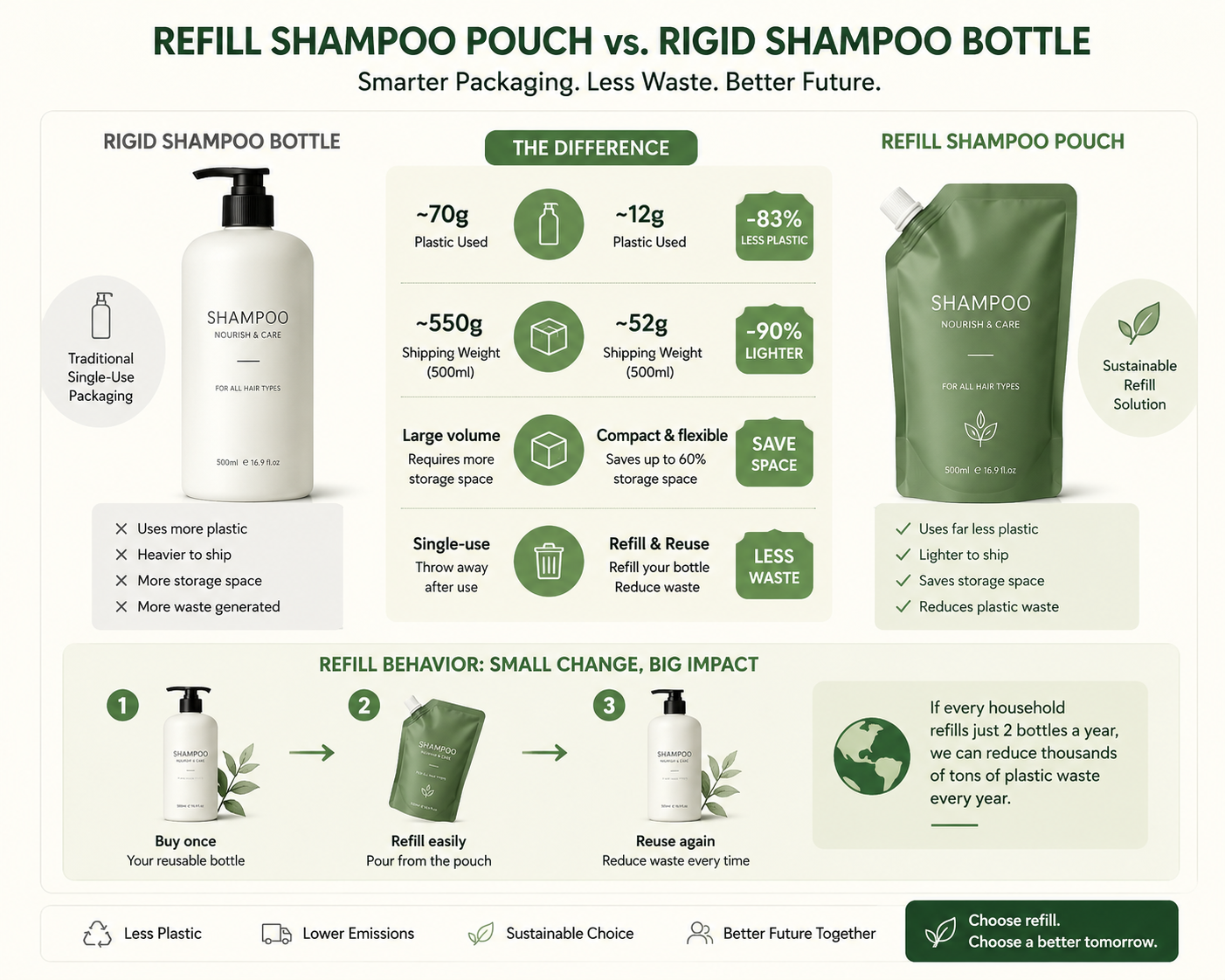
Eco friendly shampoo packaging is also about logistics efficiency
When B2B buyers evaluate eco friendly shampoo packaging, they often focus on the visible package. But the supply chain impact can be just as important. Flexible refill pouches can take up less space before filling compared with rigid bottles. This can reduce inbound packaging volume for manufacturers and contract fillers. After filling, pouches may also improve case packing efficiency depending on size, shape, cap position, and carton design.
Lower package weight can influence transportation emissions and freight cost, especially for brands shipping across regions or selling through e-commerce. A full truck, container, or warehouse pallet is not only limited by weight; it is also limited by space. Pouches can help improve product-to-packaging ratio, which is a key metric for packaging efficiency. For large hair care programs, even small improvements can become meaningful when multiplied across hundreds of thousands or millions of units.
Salons are another important channel. Professional hair care is used in high volume, and salon owners often care about storage space. Refill pouches can make backbar inventory easier to store and replenish. A salon may keep premium dispensing bottles at wash stations while receiving larger refill pouches for operational use. This model can reduce visible clutter and strengthen the professional image of the brand.
Hotels and hospitality groups also have strong reasons to review refill pouch systems. Many hotels are moving away from small single-use amenity bottles. A refill model can support larger dispensers while allowing housekeeping teams to refill product efficiently. For suppliers selling to hospitality, pouch durability, cap design, tamper resistance, and clean pouring become important procurement criteria.
What a shampoo pouch manufacturer contributes to a refill program
Choosing the right shampoo pouch manufacturer is one of the most important decisions in a refill project. A pouch may look simple from the outside, but its performance depends on many technical factors. These include film structure, seal design, pouch geometry, spout placement, cap selection, printing method, filling temperature, product viscosity, drop resistance, chemical resistance, and carton configuration.
A capable shampoo pouch manufacturer should do more than quote a unit price. The manufacturer should help the buyer match the pouch format to the product and sales channel. For example, a 250 ml refill pouch for premium retail may require a different structure and printing finish than a 1 liter salon refill pouch. A high-viscosity conditioner may require a wider spout than a thin shampoo. A pouch sold through e-commerce may need stronger seals and secondary protection than a pouch sold only in-store.
Brand owners should ask whether the manufacturer can support prototype development, small-batch sampling, filling trials, compatibility testing, and scale-up. They should also ask about minimum order quantity, lead time, artwork requirements, printing tolerances, recyclable or mono-material options, post-consumer recycled content availability, and documentation for claims. If the product will be sold in several countries, the buyer should confirm whether disposal claims and material language are appropriate for each market.
A strong manufacturer can also advise on user experience. The pouch should be easy to hold, open, pour, and close. It should stand reliably if the design is a stand-up pouch. The cap should match the viscosity and consumer behavior. The spout should reduce dripping. The surface should allow clear printing of instructions and regulatory information. These details may appear small, but they influence reviews, returns, and repurchase.
Refill shampoo pouch design choices B2B buyers should evaluate
The best refill shampoo pouch design depends on the product, price point, channel, and sustainability goal. Before selecting a pouch, B2B buyers should define the refill system clearly. Is the pouch intended to refill a premium bottle? Is it a lower-cost value pack? Is it for salon professionals? Is it for hotel operations? Is it part of a subscription model? Each answer changes the design requirements.
- Volume: Common refill sizes may include 250 ml, 300 ml, 400 ml, 500 ml, 750 ml, or 1 liter, depending on the market and product type.
- Pouch type: Stand-up pouches are useful for retail display, while larger refill packs may prioritize strength and pouring efficiency.
- Spout and cap: The cap must match the formula viscosity and prevent leakage during storage and transport.
- Film structure: The structure should protect fragrance, color, viscosity, and formula stability while supporting the brand’s sustainability claims.
- Print quality: Premium hair care brands may require high-quality graphics, tactile effects, matte finishes, or clean minimalist printing.
- Recyclability: Recyclability depends on material structure and local infrastructure, so claims must be market-specific.
- Filling compatibility: The pouch must work with the filler’s equipment, filling speed, sealing conditions, and quality control process.
- Transportation testing: Drop, compression, vibration, and leakage testing are essential, especially for e-commerce and export.
These decisions should be made before artwork is finalized. If a brand designs the label first and chooses the pouch later, it may face delays because pouch shape, spout area, seal zones, and printing limitations affect the final layout. Early coordination between the brand, filler, designer, and shampoo pouch manufacturer reduces revision cycles and protects launch timing.
Sustainable hair care packaging must avoid greenwashing risk
As refill packaging becomes more common, the risk of weak sustainability claims also increases. Buyers are more sophisticated than before. Retailers may ask for proof. Consumers may compare claims online. Regulators may challenge vague language. Therefore, sustainable hair care packaging must be communicated with accuracy.
Instead of saying “100% eco friendly,” a brand can say “designed to reduce plastic use compared with our standard bottle” if it has the data to support that claim. Instead of saying “recyclable everywhere,” a brand can say “check local recycling guidance” if collection systems vary by market. Instead of saying “zero waste,” a brand can explain how the refill system reduces packaging material over repeated use.
For B2B suppliers, honest language can actually strengthen credibility. Professional buyers understand that packaging decisions involve trade-offs. A pouch may reduce weight but still require specialized recycling. A mono-material structure may improve recyclability but require testing for barrier performance. A paper-based appearance may look sustainable but may not be suitable for wet bathroom environments. The supplier that explains these trade-offs clearly is more likely to earn trust.
For B2B hair care brands, the strongest refill strategy is not the loudest sustainability claim. It is the packaging system that can be measured, tested, repeated, and explained.
Eco friendly shampoo packaging and the premium beauty experience can work together
Some premium brands worry that eco friendly shampoo packaging may reduce the perceived value of the product. This concern is understandable. Beauty packaging is not only a container; it is part of the product experience. The weight of the bottle, the finish, the cap, the label, and the shelf presence all influence how consumers judge quality. However, refill pouches do not have to replace premium packaging completely. They can extend it.
A premium brand can sell a durable, beautiful bottle as the main object and then offer refill pouches as the responsible way to continue using it. In this model, the bottle becomes part of the brand world. It may be made from high-quality PET, aluminum, glass, or another durable material. The pouch becomes the efficient refill format. The consumer keeps the premium experience while reducing the packaging attached to each repeat purchase.
This structure is especially powerful for salon-quality hair care. Consumers often trust professional brands because they associate them with expertise and performance. A refill system can reinforce that trust by showing that the brand has thought about long-term use, not just first purchase. The packaging story becomes practical: buy the bottle once, refill it with the formula you already love, and reduce unnecessary packaging with every repeat.
For private label and contract manufacturing, refill pouches can also help retailers create tiered product lines. A retailer may offer an entry-level bottle, a premium reusable bottle, and a refill pouch for the same formula. This gives shoppers multiple price points and sustainability choices without requiring multiple formulas.
How refill shampoo pouch packaging affects retail and e-commerce strategy
A refill shampoo pouch changes how a hair care product is sold. In physical retail, the pouch must stand out while also explaining its purpose quickly. Consumers need to understand that it is a refill, what bottle it refills, how much product it contains, and why it is a better choice. Clear front-panel communication matters. The refill benefit should not be hidden in small text.
In e-commerce, the product page must do more of the education. Images should show the pouch, the reusable bottle, the pouring step, and the material reduction claim. The page should answer common questions: Is the formula the same as the bottled shampoo? How many bottle refills does one pouch provide? Can the pouch be closed after partial use? How should it be stored? Is it recyclable in the customer’s area?
Subscription models are another opportunity. Once a customer owns the bottle, the brand can send refill pouches on a schedule. This works especially well for families, salons, and consumers with consistent routines. Subscription refills can improve forecasting for the brand and reduce customer acquisition cost over time.
However, refill pouches require careful SKU planning. The brand must avoid confusing the consumer with too many similar formats. If the bottle is 300 ml and the pouch is 500 ml, the packaging should explain whether the pouch fills the bottle once with extra product remaining or whether it is intended for multiple uses. Simple instructions reduce friction and improve customer satisfaction.
What B2B buyers should ask before choosing a shampoo pouch manufacturer
Before selecting a shampoo pouch manufacturer, buyers should prepare a detailed brief. This brief should include product type, formula viscosity, fill volume, target market, retail channel, expected annual volume, sustainability goals, artwork needs, filling location, and launch timeline. The more complete the brief, the more accurate the manufacturer’s recommendation will be.
- What pouch structures do you recommend for shampoo, conditioner, and hair treatments?
- Can you support formula compatibility testing before mass production?
- What spout sizes are available for different viscosities?
- Can the pouch be designed as a mono-material option?
- What documentation can you provide for material claims?
- What is the minimum order quantity for custom printing?
- Can you provide samples for filling-line trials?
- What leakage, drop, seal strength, and transport tests are available?
- How do you control printing consistency across repeat orders?
- What lead times should we expect for sampling, tooling, printing, and mass production?
These questions help buyers separate a basic pouch supplier from a strategic packaging partner. In B2B hair care, the lowest unit price is rarely the best decision if the result is leakage, poor shelf appearance, unstable supply, or unsupported sustainability claims. A good shampoo pouch manufacturer helps reduce risk across the full launch cycle.
Refill shampoo pouch opportunities for brands, salons, hotels, and private label
The refill shampoo pouch is flexible because it can serve many B2B channels. For consumer brands, it supports retail and direct-to-consumer refill strategies. For salons, it supports professional backbar efficiency. For hotels, it supports larger dispenser refill systems. For private label, it creates a sustainable packaging option that retailers can add to existing hair care lines.
In mass retail, refill pouches can be positioned as value and sustainability products. The shopper sees that the refill contains more product or uses less packaging than buying another bottle. In premium retail, the pouch can be positioned as a sophisticated continuation of the original bottle experience. In salons, the pouch can be positioned as operationally efficient and aligned with professional responsibility. In hospitality, it can be positioned as a practical replacement for small amenity bottles.
Private label buyers should pay special attention to differentiation. Many shampoo formulas look similar on shelf, but packaging format can make a product feel more current. A refill pouch can help a retailer show that its own brand is responding to modern packaging expectations. It can also create larger basket value when sold with a starter bottle.
For distributors, refill pouches may open new conversations with existing customers. Instead of selling only standard bottles, the distributor can offer a refill system, merchandising support, and operational guidance. This can strengthen the relationship and create recurring sales.
Sustainable hair care packaging needs consumer education
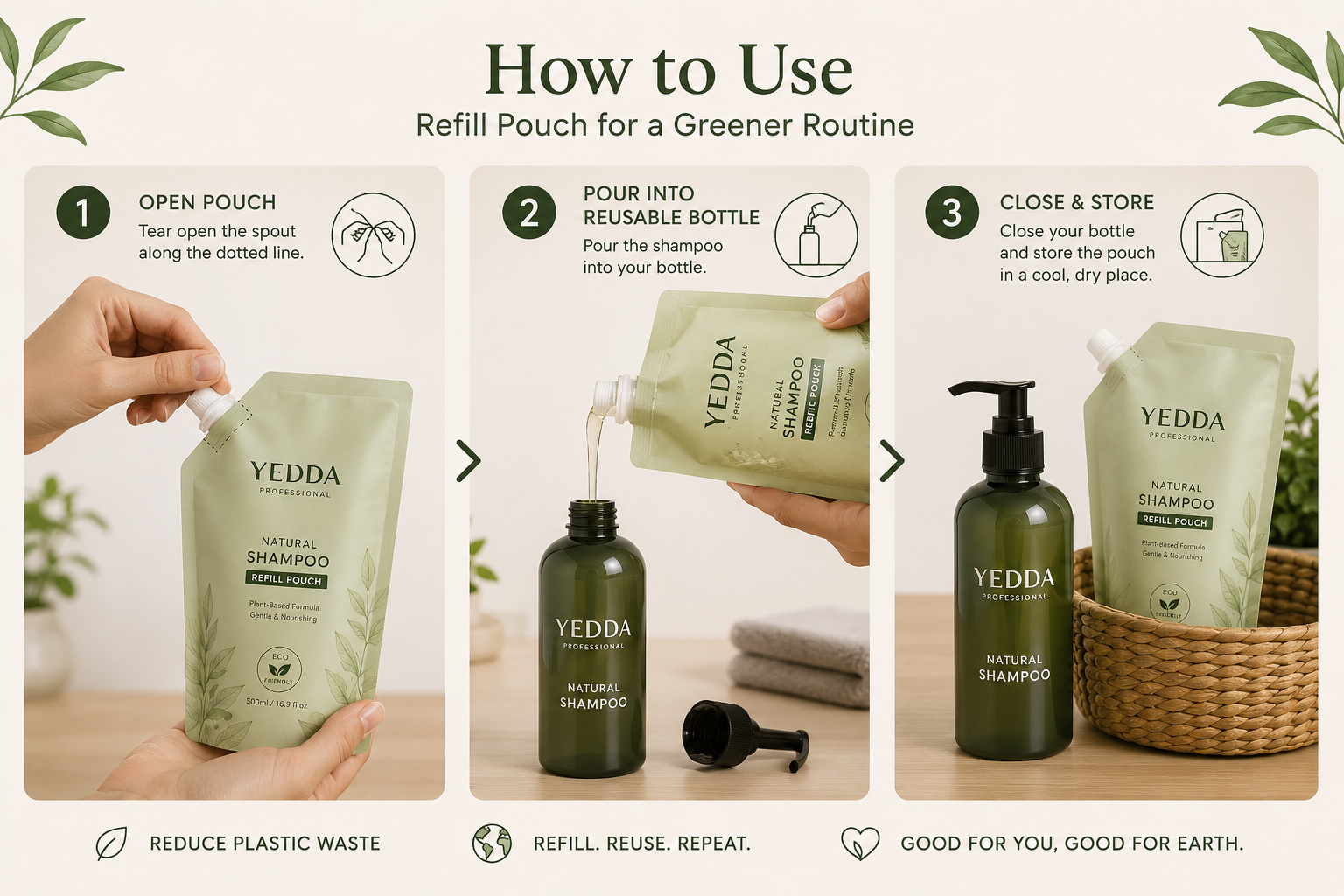
Even the best sustainable hair care packaging can fail if consumers do not understand how to use it. Refill pouches are familiar in some categories and markets, but not universal. Clear education is essential. The pouch should explain that the formula is the same as the bottled product, show how to pour it, tell the user whether to rinse the bottle first, and explain how to close and store the pouch if not fully used.
Education should also be visible across the website, product page, retail display, and social content. A short video showing the refill process can reduce hesitation. Product photography should show the pouch next to the bottle so consumers understand the system. Reviews should be monitored for comments about pouring, leakage, cap usability, and storage. This feedback can guide the next production run.
For B2B buyers, consumer education is not only a marketing task. It affects return rates, customer service questions, repeat purchase, and retailer confidence. If the refill experience is easy, the buyer is more likely to expand the program. If the consumer is confused, the program may underperform even if the packaging is technically strong.
Eco friendly shampoo packaging should be measured through the full lifecycle
A mature eco friendly shampoo packaging strategy should evaluate the full lifecycle, not only the visible pack. The assessment should consider raw material, production, filling, transport, storage, consumer use, refill frequency, and end-of-life. A refill pouch can perform well on material reduction, but the final benefit depends on how many times the original bottle is reused and how the pouch is disposed of after use.
For internal decision making, brands can compare several scenarios. Scenario one: the consumer buys a new bottle every time. Scenario two: the consumer buys one bottle and one refill pouch. Scenario three: the consumer buys one bottle and three refill pouches. Scenario four: the consumer subscribes to refill pouches over a year. These scenarios can show when the refill system becomes most beneficial.
B2B buyers should also consider secondary packaging. If a pouch requires excessive protective packaging for e-commerce, some benefits may be reduced. If the pouch is sold in-store with minimal secondary packaging, the result may be stronger. The right channel strategy can improve the overall sustainability profile.
The most credible approach is to collect real data after launch. Track refill sales as a percentage of total sales. Track repeat purchase. Track customer complaints related to leakage or pouring. Track returns and damages. Track the number of consumers buying the starter bottle and later buying the refill. This data helps the brand improve the packaging and support future sustainability reports.
Why refill shampoo pouch programs fail and how to avoid it
Refill programs can fail when the brand treats the pouch as a simple packaging swap rather than a system. One common mistake is launching a refill pouch for a product that does not have strong repeat purchase. If consumers are not loyal to the formula, they may not buy the refill. Another mistake is making the refill hard to find. If the pouch is not available where the consumer expects to repurchase, the habit does not form.
A third mistake is poor pricing. If the refill pouch is almost the same price as the full bottle, consumers may not see enough value. If it is too cheap, the brand may damage premium perception or margin. The best pricing depends on product positioning, packaging cost, channel margin, and consumer expectations.
A fourth mistake is weak instructions. Some consumers may not know whether the pouch is poured into the original bottle, used directly, or stored after opening. Clear usage directions can solve this. A fifth mistake is choosing the wrong shampoo pouch manufacturer. If the pouch leaks, fails drop tests, has poor print quality, or does not match the filling line, the launch can become expensive.
To avoid these issues, brands should begin with a hero product, test the pouch with real users, confirm filling performance, validate shipping, and create a simple communication plan. Refill packaging works best when product loyalty, packaging design, consumer education, and channel execution are aligned.
How shampoo pouch manufacturer selection affects brand reputation
In B2B hair care, packaging failure is not only a technical issue. It is a brand reputation issue. A leaking pouch can damage other products in a shipment. A weak cap can create negative reviews. Poor printing can make a premium formula look cheap. An unsupported sustainability claim can create retailer concerns. This is why the shampoo pouch manufacturer plays a direct role in brand trust.
Buyers should evaluate the manufacturer’s experience in personal care, not only food or household products. Shampoo and conditioner formulas have specific requirements. They may be slippery, viscous, fragrant, or chemically active. They may be filled hot or cold depending on the process. They may require special attention to oxygen, moisture, fragrance retention, or seal contamination. A manufacturer with personal care experience is more likely to understand these details.
Quality control should also be discussed early. The buyer should understand how the supplier checks film quality, print accuracy, seal integrity, spout bonding, cap fit, and batch consistency. For export products, documentation and traceability may be required. For large retailers, packaging specifications may need to be submitted before approval.
A good manufacturer can also help optimize the pouch for cost without weakening performance. For example, it may recommend a more efficient pouch size, a better spout location, a simplified print process, or a structure that balances barrier and recyclability. This kind of technical guidance is valuable for brands that want both sustainability and commercial scalability.
Refill shampoo pouch packaging can strengthen B2B sales messaging
For suppliers selling hair care products to retailers, salons, hotels, or distributors, refill packaging can become a strong sales story. The message should be built around business value, not only environmental value. Buyers want to know how the pouch helps them sell more, reduce risk, meet customer expectations, and differentiate their assortment.
A strong B2B sales message may include several points. The refill shampoo pouch reduces packaging material compared with repeatedly buying rigid bottles. It supports repeat purchase because consumers keep the bottle and return for refills. It can improve storage and shipping efficiency. It gives retailers a visible sustainability story. It allows salons and hotels to reduce reliance on small single-use containers. It can be launched first with bestselling formulas to control risk.
The message should also include proof. If the brand has test data, material reduction figures, customer reviews, or repeat purchase results, these should be included in buyer presentations. If the pouch structure has been tested for leakage and transport, that should be stated. If the supplier can provide documentation, that should be part of the pitch.
For a shampoo pouch manufacturer, the B2B message should focus on capability. Can the factory support custom sizes? Can it provide spouted pouches for viscous formulas? Can it help with recyclable structures? Can it manage export orders? Can it support private label artwork? Can it scale from trial orders to mass production? These are the points that matter to professional buyers.
Future trends in sustainable hair care packaging
The next stage of sustainable hair care packaging will likely be more technical, more measurable, and more localized. Brands will not only ask whether a pouch uses less plastic. They will ask whether it can be recycled in a specific market, whether the material structure can be simplified, whether recycled content can be included, whether the cap can be improved, and whether the refill system can be integrated into e-commerce subscriptions or retail loyalty programs.
More brands may also combine refill pouches with durable bottles. Aluminum bottles, premium PET bottles, PCR bottles, and reusable dispensers can all become part of the refill ecosystem. The bottle carries the brand identity, while the pouch carries the refill function. This division of roles allows brands to maintain strong visual identity while reducing repeated packaging material.
Another trend is channel-specific pouch design. A retail pouch, salon pouch, hotel pouch, and e-commerce pouch may all use different specifications. This is similar to how bottles already vary by channel. The refill pouch category will become more sophisticated as brands collect more performance data.
Regulation will also influence packaging choices. As extended producer responsibility policies, packaging reporting rules, and plastic reduction targets expand, brands will need better documentation. A shampoo pouch manufacturer that can provide material specifications, test reports, and sustainability documentation will become more valuable.
Conclusion: refill shampoo pouch packaging is a strategic move for the hair care industry
The transformation of the hair care industry is not only about new formulas, new fragrances, or new claims. Packaging is becoming a central part of product strategy. The refill shampoo pouch is gaining attention because it connects sustainability, repeat purchase, logistics efficiency, and brand differentiation. It gives consumers a practical way to reduce repeated bottle purchases. It gives retailers a visible sustainability story. It gives salons and hotels a more efficient refill option. It gives manufacturers and private label brands a scalable format for modern hair care lines.
For B2B buyers, the key is to treat refill pouches as a system. The pouch must match the formula, filling line, sales channel, consumer behavior, sustainability claim, and brand positioning. The manufacturer must be able to support testing, documentation, printing, quality control, and scale. The brand must educate consumers and track real performance after launch.
When executed well, sustainable hair care packaging does not force brands to choose between performance and responsibility. A well-designed refill pouch can protect the product, support premium branding, reduce packaging material, and create a repeat-purchase model. That is why refill pouches are not just another packaging trend. They are becoming one of the most practical routes toward eco friendly shampoo packaging in the modern hair care market.
FAQ
What is a refill shampoo pouch?
A refill shampoo pouch is a flexible pouch designed to refill an existing shampoo bottle or dispenser. It usually uses less packaging material than buying another rigid bottle and is commonly used for shampoo, conditioner, hair masks, salon products, and hospitality hair care systems.
Is a refill shampoo pouch always more sustainable than a bottle?
A refill pouch can reduce packaging material, but the final sustainability benefit depends on the pouch structure, transport, refill frequency, end-of-life options, and whether the original bottle is reused. Brands should test and measure the full system before making strong sustainability claims.
How should brands choose a shampoo pouch manufacturer?
Brands should choose a shampoo pouch manufacturer with personal care packaging experience, formula compatibility knowledge, strong sealing quality, spout and cap options, custom printing capability, testing support, and documentation for material or sustainability claims.
Why is eco friendly shampoo packaging important for B2B buyers?
Eco friendly shampoo packaging helps B2B buyers respond to retailer expectations, consumer demand, regulatory pressure, and internal sustainability goals. It can also improve differentiation, support refill-based repeat purchase, and reduce reliance on single-use rigid packaging.
```