
The Hair Care Industry Is Entering the Scalp Care Era
Consumers increasingly understand that healthy hair begins with a healthy scalp. This shift has created massive opportunities for salon brands, distributors, Amazon sellers, and emerging beauty startups looking to launch premium scalp-focused product lines through OEM and private label manufacturing.
As a result, scalp care is becoming one of the fastest-growing categories in the professional hair care industry. From anti-dandruff shampoos and scalp detox systems to microbiome-friendly formulations and hair loss treatments, scalp-focused innovation is reshaping the future of OEM hair care manufacturing.
According to Grand View Research, increasing consumer demand for personalized and wellness-oriented beauty products continues driving strong global growth in the scalp care and hair treatment industry.
For decades, most consumers viewed shampoo as a simple cleansing product. Today, that mindset has changed dramatically.
Modern consumers increasingly associate scalp health with:
- Hair growth performance
- Reduced hair thinning
- Oil balance
- Scalp microbiome stability
- Long-term hair strength
- Sensitivity reduction
This trend is often described as the “skinification of hair care,” where consumers treat the scalp similarly to facial skincare.
As skincare ingredients like niacinamide, peptides, probiotics, salicylic acid, and ceramides become increasingly common in hair products, OEM manufacturers are rapidly investing in advanced scalp care formulation systems.
The result is explosive growth for:
- Scalp care products
- Scalp treatment OEM services
- Scalp shampoo manufacturers
- Hair growth product suppliers
- Professional scalp therapy brands
Why Scalp Care Products Are One of the Hottest B2B Keywords in 2026
Search demand for scalp-focused products has increased significantly across Google, TikTok, Amazon, and beauty retail platforms.
Consumers are no longer searching only for “shampoo.” Instead, they now search for highly targeted solutions such as:
- Scalp detox shampoo
- Scalp repair treatment
- Hair growth scalp serum
- Anti-dandruff scalp therapy
- Sensitive scalp shampoo
- Microbiome scalp products
- Scalp exfoliating treatment
This shift has dramatically changed B2B sourcing behavior.
Brands increasingly prefer OEM hair care manufacturers capable of:
- Custom scalp treatment formulation
- Low-irritation surfactant systems
- Clinical ingredient integration
- Functional active testing
- Scalp microbiome research support
- Dermatologically inspired product development
According to Mintel Beauty Research, scalp-focused beauty products are among the fastest-growing categories in global hair care innovation.
The Rise of Scalp Treatment OEM Manufacturing

OEM manufacturing is becoming the preferred model for emerging scalp care brands.
Launching scalp treatment products requires specialized expertise in:
- Ingredient compatibility
- Microbial stability
- Preservative systems
- Botanical extraction technology
- Scalp sensitivity testing
- Formula stability validation
Most new brands lack the infrastructure necessary to manage these processes independently.
As a result, companies increasingly rely on professional scalp treatment OEM manufacturers for:
- Formula research and development
- Packaging engineering
- Regulatory compliance
- Scalable production
- International export support
OEM manufacturers allow beauty brands to focus on marketing, distribution, and brand positioning while outsourcing technical manufacturing operations to specialized facilities.
Top Trending Ingredients in Scalp Care Formulations
Ingredient transparency has become one of the biggest purchasing drivers in the global beauty market.
Consumers increasingly prefer clinically supported and naturally positioned ingredients for scalp wellness products.
The most in-demand scalp care ingredients in 2026 include:
- Rosemary oil
- Niacinamide
- Tea tree oil
- Salicylic acid
- Biotin
- Caffeine extract
- Peppermint oil
- Peptides
- Probiotic ferment complexes
- Centella asiatica extract
Many scalp shampoo manufacturers are now combining botanical extracts with biotech ingredients to create products positioned as both natural and scientifically advanced.
This hybrid positioning performs particularly well in:
- Professional salon products
- Luxury scalp therapy collections
- Hair loss prevention systems
- Sensitive scalp treatment lines
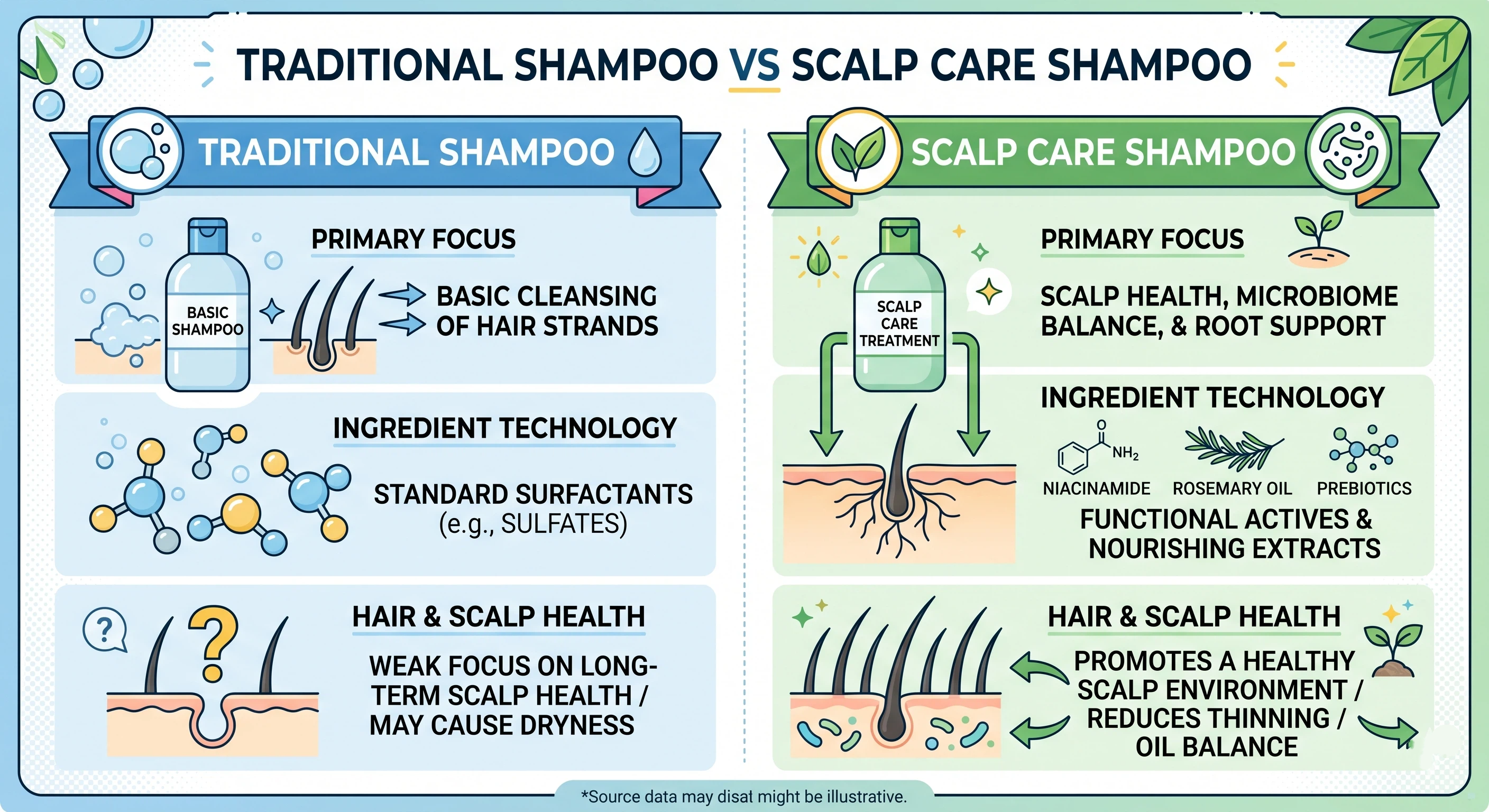
Comparison Table: Traditional Shampoo vs Scalp Care Shampoo
| Feature | Traditional Shampoo | Scalp Care Shampoo |
|---|---|---|
| Primary Focus | Basic Cleansing | Scalp Health & Hair Wellness |
| Ingredient Technology | Standard Surfactants | Functional Active Ingredients |
| Target Consumers | Mass Market | Premium & Problem-Solving Buyers |
| Hair Growth Positioning | Weak | Strong |
| Consumer Trend Growth | Stable | Rapidly Growing |
| Average Product Margin | Lower | Higher |
Why Salon Brands Are Investing in Scalp Care Products
Professional salon channels are increasingly shifting toward scalp wellness services because they generate:
- Higher customer retention
- Premium treatment pricing
- Repeat product purchases
- Long-term client loyalty
Salon scalp care systems often include:
- Scalp detox shampoo
- Scalp exfoliating scrub
- Hair growth tonic
- Cooling scalp serum
- Professional scalp massage treatment
This has created strong demand for OEM manufacturers capable of developing complete professional scalp therapy systems instead of single standalone products.
Scalp Microbiome Technology Is Becoming a Major Innovation Trend
One of the most advanced trends shaping the scalp care industry is microbiome-focused formulation technology.
The scalp microbiome refers to the ecosystem of microorganisms naturally living on the scalp surface.
When this balance becomes disrupted, consumers may experience:
- Dandruff
- Scalp irritation
- Excessive oil production
- Hair thinning
- Inflammation
Modern scalp treatment OEM manufacturers are increasingly developing formulas designed to support microbiome balance through:
- Probiotic ingredients
- Prebiotic complexes
- Fermented botanical extracts
- Low-irritation cleansing systems
This category is expected to become one of the next major growth drivers in luxury hair care.
The Growing Demand for Sulfate-Free Scalp Shampoo
Sulfate-free products continue dominating premium hair care trends in 2026.
Consumers increasingly associate sulfate-free scalp shampoos with:
- Reduced irritation
- Color protection
- Scalp barrier support
- Gentler cleansing
- Moisture retention
This trend is pushing scalp shampoo manufacturers to develop advanced surfactant systems using:
- Amino acid surfactants
- Coconut-derived cleansers
- Sugar-based cleansing agents
Many premium scalp care brands now combine sulfate-free positioning with:
- Silicone-free systems
- Vegan formulations
- Clean beauty marketing
- Dermatologist-tested positioning
Comparison Table: OEM Scalp Care Manufacturing vs In-House Production
| Factor | OEM Manufacturing | In-House Production |
|---|---|---|
| Initial Investment | Lower | Very High |
| R&D Capability | Professional Support | Requires Internal Team |
| Production Flexibility | High | Limited |
| Speed to Market | Faster | Slower |
| Regulatory Support | Included | Self-Managed |
| MOQ Flexibility | Available | Usually High |
Why Low MOQ Scalp Care Manufacturing Is Trending
The rise of TikTok beauty brands, Amazon sellers, and independent salon brands has created massive demand for low MOQ manufacturing solutions.
Modern startups increasingly seek:
- Small batch scalp care production
- Rapid sample development
- Flexible packaging options
- Private label scalp shampoo systems
- Fast product launch timelines
Low MOQ scalp treatment OEM services allow brands to:
- Reduce inventory risk
- Test market demand faster
- Launch seasonal products
- Improve cash flow flexibility
This has become especially important in the rapidly changing beauty industry where trend cycles move extremely quickly.
How AI Technology Is Transforming Scalp Care Manufacturing
Artificial intelligence is beginning to play a major role in OEM hair care product development.
Advanced scalp shampoo manufacturers now use AI-assisted systems for:
- Ingredient analysis
- Formula stability prediction
- Consumer trend forecasting
- Product performance optimization
- Manufacturing efficiency improvement
AI technology helps manufacturers reduce product development timelines while improving formulation precision and product consistency.
This is particularly valuable for scalp treatment products where ingredient balance and sensitivity management are critical.
Sustainability Is Becoming Essential in Scalp Care Manufacturing
Environmental sustainability is becoming increasingly important for international beauty buyers.
Many global distributors and retailers now require:
- PCR packaging materials
- Refillable packaging systems
- Cruelty-free production
- Vegan formulation options
- Eco-friendly ingredient sourcing
Regulatory Standards Are Becoming More Important
International cosmetic compliance requirements continue becoming stricter across major markets.
Professional scalp treatment OEM manufacturers increasingly require:
- ISO 22716 certification
- GMP manufacturing systems
- Microbial testing procedures
- Ingredient traceability systems
- Stability testing protocols
- Safety assessment documentation
According to the U.S. FDA Cosmetics Guidance, cosmetic manufacturers must maintain appropriate safety standards and labeling compliance for international distribution.
The Future of Scalp Care Products in the Global Beauty Industry
The future of the hair care industry will increasingly focus on scalp wellness, personalized treatment systems, and scientifically advanced formulations.
The fastest-growing future categories are expected to include:
- Microbiome scalp care
- AI-personalized hair treatment
- Hair growth therapy systems
- Scalp anti-aging products
- Waterless scalp treatment products
- Biotechnology-based hair care ingredients
Brands that invest early in scalp-focused innovation will likely gain strong competitive advantages as consumer awareness continues growing globally.
Conclusion
Scalp care is rapidly becoming the future of the global hair care industry. As consumers increasingly prioritize scalp wellness, hair growth, and ingredient transparency, demand for advanced scalp care products continues accelerating worldwide.
For salon brands, distributors, Amazon sellers, and emerging beauty companies, partnering with a professional scalp shampoo manufacturer or scalp treatment OEM supplier provides major advantages in formulation innovation, speed-to-market, and scalable production.
Manufacturers capable of combining clean beauty positioning, advanced scalp science, sustainable packaging, flexible MOQ systems, and global compliance standards will lead the next generation of B2B hair care manufacturing.
Frequently Asked Questions (FAQ)
1. What are scalp care products?
Scalp care products are specialized hair care formulations designed to improve scalp health, reduce irritation, balance oil production, and support stronger hair growth. These products include scalp shampoos, scalp serums, exfoliating treatments, anti-dandruff solutions, and microbiome-focused hair care systems.
Unlike traditional shampoos that mainly focus on cleansing hair strands, modern scalp care products target the root cause of common hair problems such as hair thinning, dandruff, sensitivity, and scalp inflammation. This category has become one of the fastest-growing segments in the global beauty industry.
2. Why are brands looking for scalp shampoo manufacturers in 2026?
Brands are increasingly partnering with scalp shampoo manufacturers because consumer demand for scalp-focused beauty products has grown rapidly. Modern consumers want clinically inspired, sulfate-free, and scalp wellness solutions that support long-term hair health and hair growth performance.
Professional manufacturers can provide advanced formulation technology, low MOQ production, OEM services, ingredient sourcing, and international compliance support. This helps brands launch premium scalp care products faster and more efficiently.
3. What is scalp treatment OEM manufacturing?
Scalp treatment OEM manufacturing is a business model where a specialized manufacturer develops and produces scalp-focused hair care products for another brand. The brand sells the products under its own label while the OEM factory manages production, formulation, and quality control.
OEM services are especially valuable for startups, salon brands, and distributors because they reduce development risks, improve speed-to-market, and provide access to professional R∧D capabilities without requiring an internal laboratory.
4. Which ingredients are most popular in scalp care formulations?
The most popular scalp care ingredients in 2026 include rosemary oil, niacinamide, tea tree oil, salicylic acid, peptides, caffeine extract, probiotics, and botanical ferment complexes. These ingredients are commonly used to support scalp balance and healthy hair growth.
Consumers increasingly prefer clean beauty formulations that combine natural extracts with scientific ingredient technology. This trend is driving strong demand for advanced scalp treatment OEM development services worldwide.
5. How do scalp care products help hair growth brands?
Scalp care products help hair growth brands by addressing the scalp environment where hair follicles develop. Healthy scalp conditions can reduce buildup, irritation, excessive oil, and inflammation, which may negatively affect hair growth performance.
As a result, many premium hair growth brands now integrate scalp detox shampoos, scalp serums, and microbiome-supporting treatments into complete hair wellness systems to improve customer retention and product effectiveness.