
From Lab Beaker to Metric Tons: When Formula Science Meets Manufacturing Reality

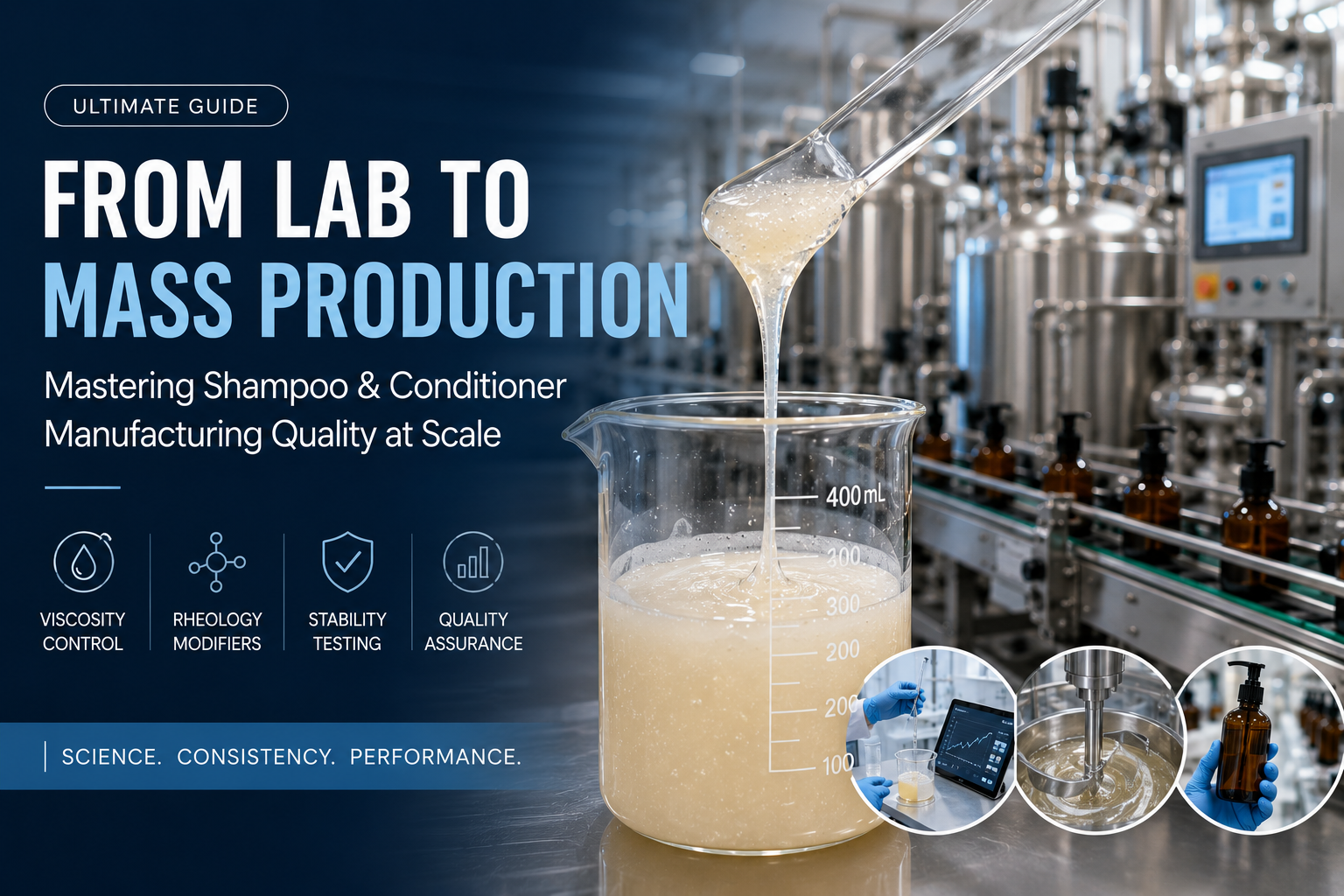
The development of a custom hair care product often begins with a few hundred milliliters of fluid in a specialized R&D lab beaker. This initial environment is near-perfect, allowing formulators precise control over heating rates, cooling cycles, and mixing intensity. However, this perfection is an illusion that shatters the moment the formula attempts to scale up to the metric ton level. Commercial scaling is not a simple linear expansion of ingredients; it is a fundamental shift in physics. A formula that is stable and aesthetically pleasing in a lab can, upon scaling, become unacceptably thin, develop micro-bubbles, separate into distinct phases, or simply fail to pour. This operational disconnect is one of the single biggest causes of product launch delays in the hair care sector.
As a leading cosmetic manufacturer with 30,000 square meters of production space, Yedda Haircare has processed thousands of formulations. We understand that success at scale relies not just on chemical knowledge, but on a deep understanding of fluid dynamics and process engineering. The core challenge lies in managing how a substance flows and deforms—its rheology. Rheology is far more than just "thickness"; it encompasses how a fluid reacts to shear stress during pumping, how it changes behavior at different temperatures, and how it holds insoluble particles in permanent suspension. When we scale a batch from 1 kilogram to 1,000 kilograms, we are scaling the surface-area-to-volume ratio, which completely alters the thermal dynamics of the system. Mixing that took five minutes in a beaker may now require 120 minutes in a jacketed vessel, exposing sensitive botanical active ingredients to prolonged heat that can lead to rapid degradation.
Furthermore, the physical behavior of surfactants, which are the foundational cleansing agents in any shampoo, changes drastically based on the concentration and mixing environment. Surfactants natively self-assemble into various micellar structures (spherical, worm-like, or planar), and these structures directly determine the texture and performance of the final product. Incorrect mixing parameters during upscaling can disrupt this delicate micellar architecture, resulting in a product that either fails to foam or becomes unworkable. In this guide, we analyze how a robust understanding of these technical parameters allows Yedda to master viscosity control and yield value, transforming a potential scaling nightmare into a seamless, reproducible industrial process.
Mastering Viscosity Control in Shampoo: Surfactant Architecture vs. External Thickeners
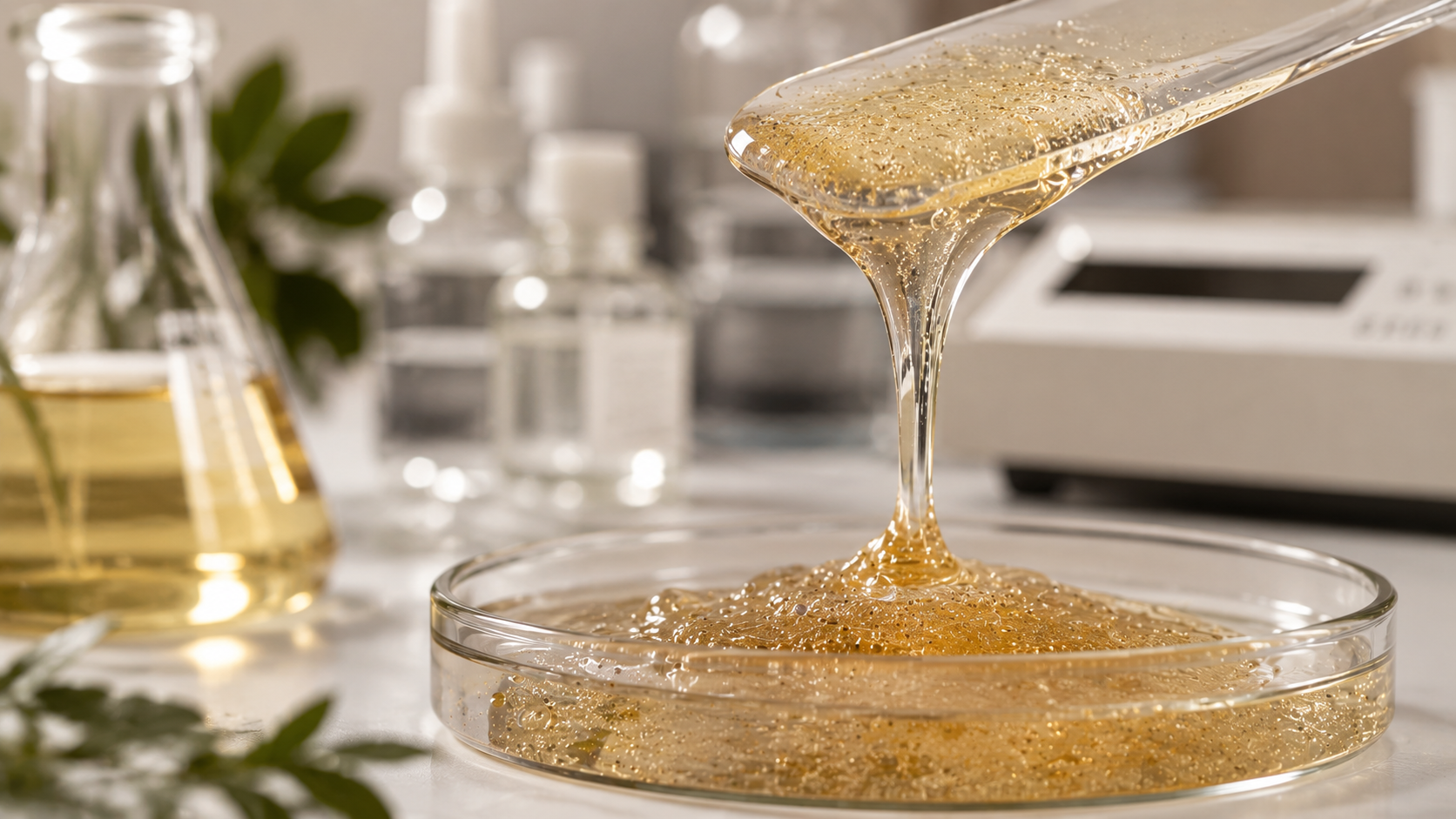
When consumers describe a shampoo as "high quality," they are almost always referring to its texture, pourability, and the way it spreads through their hair. These sensory attributes are all governed by one metric: viscosity. Achieving the perfect viscosity, however, is not a matter of simply adding a "thickener." It is a multi-step engineering challenge that requires the precise coordination of multiple formulation strategies, primarily focusing on Viscosity Control in Shampoo.
The primary method of viscosity control used in professional formulation is maximizing the intrinsic thickening potential of the primary surfactant system. Surfactants do not remain as isolated molecules in a solution; they self-organize into groups called micelles. At low concentrations, these micelles are spherical, and the fluid remains thin. However, by carefully selecting the ratio of different surfactants—such as blending anionic surfactants (e.g., Sodium Laureth Sulfate or Sodium Cocoyl Isethionate) with secondary amphoteric surfactants (e.g., Cocamidopropyl Betaine)—we can drive a transition from spherical micelles into much longer, entangled, "worm-like" micelles. These entangled networks create a significant internal resistance to flow, effectively thickening the shampoo from the inside out without the need for external additives. This approach ensures maximum clarity and a luxurious, smooth sensory profile.
Another powerful tool in Viscosity Control in Shampoo is the salt curve response. For many anionic surfactant systems, the addition of small amounts of electrolytes, such as Sodium Chloride, screening the electrostatic repulsion between surfactant head groups, encouraging micellar growth and entanglement, thereby increasing viscosity. However, every surfactant blend has an optimal "peak" viscosity on its salt curve; adding too much electrolyte beyond this point will cause the micellar network to collapse, leading to an immediate and irreversible loss of viscosity—a common scaling error that Yedda's automated dosing systems are designed to prevent.
Yedda's control protocols for viscosity extend beyond the formulation itself to the mixing process. We utilize multi-stage agitation systems that combine slow-speed anchor scrapers for thorough heat transfer and batch uniformity, with high-speed, high-shear inline homogenizers. This ensures that micellar structures are encouraged to form and entangle uniformly, preventing the localized thin spots or localized gel formation that often occur in large-scale tanks equipped with only simple mixers. By precisely controlling the shear rates and cooling cycles, we guarantee that the specific, target viscosity is achieved and replicated in every metric ton produced, meeting the exact sensory expectations of your private label brand.
The Rheology Modifiers in Hair Care: Building Complex Yield Value Networks
While viscosity control manages the thickness and flow of the shampoo fluid, many advanced hair care formulations require a product to hold heavy insoluble particles—such as moisturizing beads, glitter, exfoliating fruit seeds, or, most commonly, anti-dandruff actives like Zinc Pyrithione—in permanent suspension. This is a challenge that viscosity alone cannot solve. If a shampoo is thick but has zero yield value, gravity will inevitably pull the dense particles to the bottom of the bottle, creating an unappealing, unusable product, a failure documented in countless customer complaints across the industry.
This is where the engineering concept of "yield value" becomes critical. Yield value is the minimum amount of force or stress that must be applied to a fluid to make it flow. If a fluid has a high yield value, it will act like a solid and hold heavy particles in suspension until a force (like squeezing the bottle) is applied, at which point it flows like a liquid. This behavior is called Bingham Plasticity, and it is built using specialized Rheology Modifiers in Hair Care.
These polymeric Rheology Modifiers in Hair Care work by creating an elaborate, interconnected, three-dimensional physical or chemical network throughout the shampoo base, much like a invisible structural scaffold:
- Cross-Linked Polysaccharides: Natural polymers like Xanthan Gum, especially when combined synergistically with Guar Gum, create networks with exceptional yield values. Their rigid structures can hold large particles in place even at low overall viscosities, giving the fluid a smooth, luxurious, "non-stringy" feel.
- Synthetic Acrylate Copolymers (Carbomers): These alkali-soluble emulsions are industry favorites for achieving crystal-clear clarity. Upon neutralization, these polymers uncoil and tangle, creating a highly efficient, high-yield value network that is perfect for suspension in clear gel shampoos or scalp treatments. Their efficiency ensures minimal impact on surfactant performance or foam quality.
- Modified Inorganic Clays: Clays like Magnesium Aluminum Silicate (Veegum) form delicate "house-of-cards" structures that provide robust yield stress. They are often used in combination with organic polymers to provide thixotropic flow, meaning the product becomes much thinner when shaken and rapidly regains its structure when at rest.
Independent research published by organizations like the Society of Cosmetic Chemists (SCC) has emphasized that maximizing yield value is the only viable method for stabilizing suspension systems in low-viscosity, sulfate-free cleansers, highlighting the critical role that proper rheological modifier selection plays in advanced product development. Yedda's R&D team uses advanced rheometers to precisely measure the yield point of every suspension formula, ensuring the polymeric network is strong enough to counter the gravitational force on the particles, guaranteeing long-term product uniformity and preventing phase separation.
The Vital Protocol: Accelerated Stability Testing Protocols at Scale
The single most dangerous scaling error is launching a product based only on its initial lab performance. A new formulation may look perfect, thick, and stable for the first two weeks, but without rigorous validation, it could develop catastrophic defects three months later, once it has been shipped globally and subjected to real-world transport and storage conditions. This is why strict Accelerated Stability Testing Protocols are the absolute cornerstone of any professional manufacturing operation.
Stability testing is the engineering process of accelerating the aging of a product by subjecting it to extreme environmental stress. The objective is to force any latent instabilities—such as phase separation (creaming or sedimentation), syneresis (weeping of liquid from a gel network), color fading, viscosity drift, or pH shifts—to manifest rapidly, allowing formulators to correct the formula or process BEFORE it reaches the consumer. At Yedda Haircare, our stability validation is a multi-phase operation that begins at the R&D level and continues through pilot production and into the final scaled batch.
A standard 28-day accelerated stability test simulates roughly six months of real-world shelf life. These tests are conducted in environmental chambers that strictly control both temperature and humidity. The standard protocol includes:
- High-Temperature Cycling: Products are held at elevated temperatures (e.g., 40, 45, or even 50 degrees Celsius) for 1, 2, 4, or 12 weeks. Heat accelerates chemical reactions and lipid oxidation, allowing us to predict long-term chemical stability and emulsifier robustness. High heat is especially critical for testing the endurance of scent profiles and the thermal stability of active ingredients like tocotrienols in Batana oil.
- Freeze-Thaw Stability (FT-Stability): Shampoos shipped during winter months often encounter freezing conditions. A freeze-thaw test subjects the product to multiple cycles of deep freezing (e.g., -10 to -20 degrees Celsius) followed by complete thawing at room temperature. This test is brutal on emulsion networks and polymeric yield value structures; a single fail often manifests as dramatic phase separation or immediate texture collapse, indicating the surfactant matrix or emulsifiers are insufficient.
- Mechanical Stress Testing (Centrifugation): We use high-speed centrifuges to subject the formula to forces thousands of times greater than gravity. This test forces particles to separate according to Stokes' Law, allowing us to predict a suspension formula's stability and resistance to creaming (floating particles) or sedimentation (sinking particles) over its entire shelf life in minutes.
- Photostability Testing: Clear bottles are exposed to controlled UV and visible light to test for color fading and active ingredient degradation. If a product fails, we recommend alternative packaging or the inclusion of specific UV absorbers.
- pH and Viscosity Monitoring: Throughout the testing cycle, products are removed and measured for any drift in pH (which can indicate microbial growth or chemical degradation) or viscosity (which can indicate polymeric network collapse).
Yedda Haircare understands that for large private label brands, a single batch failure could mean a multi-million dollar recall and devastating reputational damage. This is why we treat accelerated stability testing not as a bureaucratic check-box, but as a mandatory, uncompromised engineering verification step. By investing weeks in strict validation protocols, we provide our clients with the confidence and peace of mind that their commercially scaled product will not only look perfect on day one but will remain functional, aesthetically pleasing, and stable throughout its entire global shelf life, regardless of the environmental conditions it encounters.
Data Synchronization and Automated Quality Control in Upscaling
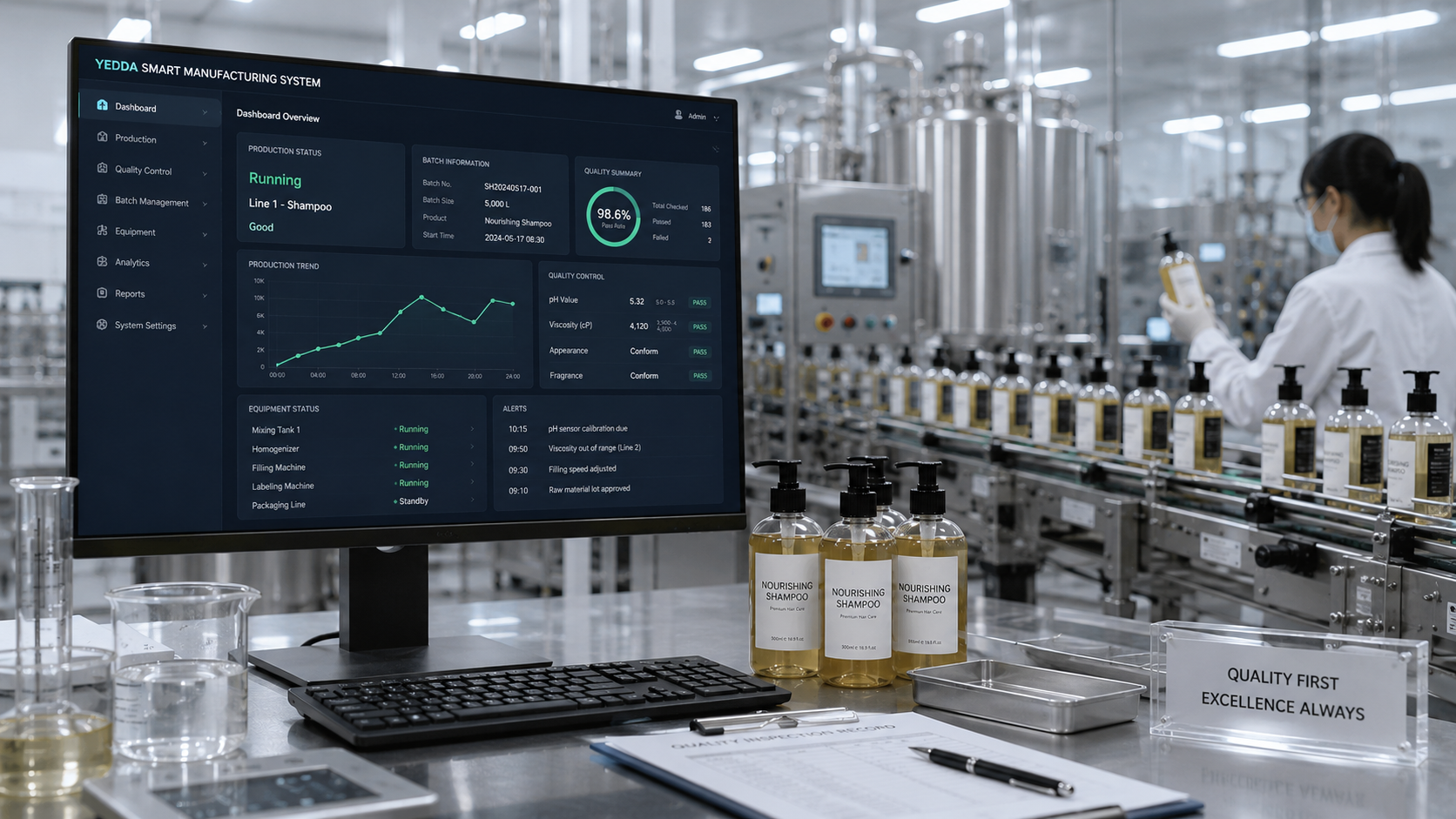
The gap between laboratory science and metric-ton manufacturing is often closed not by chemical knowledge, but by data synchronization and automated process control. At Yedda Haircare, we utilize a fully integrated manufacturing execution system (MES) that synchronizes every parameter from our R&D pilot lab directly to our massive 3-ton compounding vessels. We rely on extensive automation to ensure that the subtle instructions developed in R&D are followed precisely in the production tank.
A formula sheet developed in a beaker isn't just a list of ingredients; it's a sequence of critical process parameters (CPPs). Upscaling is the process of translating these CPPs to industrial machinery. When we scale a suspension formula, our system automatically calculates and manages the shear rates of the homogenizer and the scraper speeds during polymer hydration, ensuring the rheological modifier creates the exact yield value network required for suspension without over-shearing the delicate polymeric chains.
Our automation systems monitor and control key parameters in real-time, including jacket temperature, core batch temperature, mixing speed, and inline pH, adjusting inputs dynamically to maintain batch uniformity. This prevents common scaling issues such as thermal hotspots that can oxidize sensitive botanical oils like Batana Oil or over-dosing electrolytes that can cause viscosity collapse. This precise control over heating and cooling rates is vital, as slow cooling over metric tons can allow lipid crystallization in Batana Oil, leading to a cloudy and unstable emulsion. Yedda's rapid-cooling technology eliminates this risk. By synchronizing R&D data with our industrial control systems, we close the loop on formulation science and process engineering, providing private label brands with unparalleled batch-to-batch consistency and absolute product reliability.
Comparison Matrix: Beaker Formulation vs. Industrial Scaling (Yedda's Control Protocol)
Review the comparison matrix below to understand the operational adjustments Yedda's engineering team implements when transitioning a successful R&D lab formula into mass commercial production. This data is critical for understanding why simply scaling ingredients linearly will not yield batch consistency at the metric ton level.
| Control Parameter | R&D Beaker Level (1 kg) | Industrial Scaling Level (1,000+ kg) | Scaling Impact & Yedda's Engineering Solution |
|---|---|---|---|
| Surface Area to Volume Ratio | High; rapid heating and cooling via hotplate or water bath. | Low; extremely slow thermal transfer through metric-ton vessels. | Slow heating/cooling damages heat-sensitive actives. Yedda uses jacketed vessels with automated steam/chilled-water loops for precise, rapid thermal control. |
| Mixing Shear Distribution | Uniform; standard magnetic stirrer or overhead mixer distributes shear evenly. | Non-uniform; simple overhead mixers create significant "dead zones." | Poor mixing causes localized gel spots or thin spots. Yedda uses multi-agitation anchor scrapers paired with high-shear inline homogenizers for absolute batch uniformity. |
| Viscosity Dosing Precision | Manual addition of electrolytes (salt) via precision pipette; rapid sensor readout. | Electrolytes must be dissolved and pre-mixed before addition to prevent localized gelation. | Localized electrolyte spikes collapse micellar networks. Yedda uses automated pre-dissolution and synchronized dosing systems to manage viscosity response curves. |
| Polymer Yield Value Network | Hydrated uniformly via manual sifting and generalized localized vortexing. | Massive polymer powders prone to clumping (fish-eyes) when added incorrectly. | Fish-eyes reduce suspension efficiency, causing particles to sediment. Yedda uses specialized powder induction systems (like vacuum-driven injectors) to ensure lump-free hydration and full yield stress development. |
FAQ
Q1: A sample formula developed by our R&D lab passes stability testing in beakers, but fails when we make a pilot batch at our current manufacturer. Viscosity drops and it starts to separate after only two freeze-thaw cycles. Why is this happening, and can Yedda fix it?
A1: This is a classic scaling failure caused by inadequate fluid dynamics and process control during upscaling. A drop in viscosity and freeze-thaw failure suggests that the micellar structure or the emulsification network, which were stable in the beaker, are being disrupted in the larger vessel. Your current manufacturer is likely either over-shearing the batch, leading to polymeric chain collapse, or under-mixing, leading to localized dead zones where the micellar network never fully forms. Furthermore, slow cooling in a metric-ton vessel can allow lipid crystallization (especially in botanical oils like Batana Oil), disrupting the emulsion matrix. Yedda can resolve this issue; our MES-integrated MES and automated mixing vessels synchronize process parameters perfectly with our advanced inline homogenizers, ensuring uniform shear and precise rapid-cooling cycles to build a robust, reproducible micellar structure that guarantees stability at scale.
Q2: We are launching a private label shampoo containing moisturizing beads, but we've seen customer reviews of other brands where the beads either sink to the bottom or float to the top. How can Yedda ensure our beads remain perfectly and permanently suspended throughout the entire life of the product?
A2: Perfect suspension is not achieved by simple thickening; it requires building high yield value, a critical component of professional fluid dynamics engineering. Beads that sink have a gravitational force greater than the fluid's yield stress. Beads that float have less force than the fluid's yield stress. Your current formula likely focuses on viscosity but ignores yield stress. Yedda solves this using advanced, multi-tiered polymeric networks (like synergistic Xanthan-Guar blends or customized Acrylate networks) specifically engineered for yield value. We determine the exact yield stress value needed based on the bead density and viscosity, and then use our high-vacuum powder induction systems to ensure these polymers are fully hydrated and cross-linked, building an invisible, structural scaffold that holds your moisturizing beads in permanent, unyielding suspension.
Q3: How does Yedda validate that our commercially scaled formula is truly stable BEFORE we launch? What is the standard process for stability testing of private label products?
A3: We consider launching without stability validation to be a severe risk. Our mandatory validation protocol involves a standardized, multi-tiered process. Once we've verified the formula visually and rheologically on day one, it enters our strict Accelerated Stability Testing Protocols. The core of this is a minimum 28-day accelerated test where samples are placed in environmental chambers and subjected to various environmental stressors. We conduct tests at temperatures ranging from 4°C to 45°C or even 50°C to simulate long-term heat exposure, along with multiple deep-freeze/thaw cycles (-20°C to room temp) to simulate extreme cold during transport. We complement this with high-speed centrifugation to rapidly force any hidden phase separation and photostability testing to check for color changes under UV. Viscosity and pH are monitored throughout, and any drift or failure triggers an immediate R&D adjustment. This extensive validation gives you the confidence that your scaled batch will remain aesthetically pleasing, functional, and stable globally, regardless of the environmental conditions.
Q4: Why can't I just scale up the ingredients linearly from a 1 kg lab beaker to a 1,000 kg batch and achieve the same result?
A4: You absolutely cannot scale up linearly because scaling changes the physical environment, not just the mass. In industrial scaling, the surface-area-to-volume ratio decreases exponentially. This fundamentally alters the fluid dynamics and thermal transfer. A hot hotplate beaker that cools in 10 minutes will take hours inside a massive steel compounded tank, exposing sensitive botanical active ingredients to prolonged heat that can lead to rapid oxidation and degradation. Furthermore, mixing shear is no longer uniform; a massive vessel has significant 'dead zones' where the micellar network won't form, and other localized spots where the product can be over-sheared, collapsing the polymeric yield value networks. Upscaling is not chemical science; it is process engineering science that manages how fluid flows, how heat transfers, and how shear is distributed—technical realities that Yedda's MES-controlled automated vessels are specifically engineered to handle.